SkyRanger® R70
Teledyne Flir · United States · also known as SkyRanger, SkyRanger R70, Aeryon SkyRanger R70 · Updated
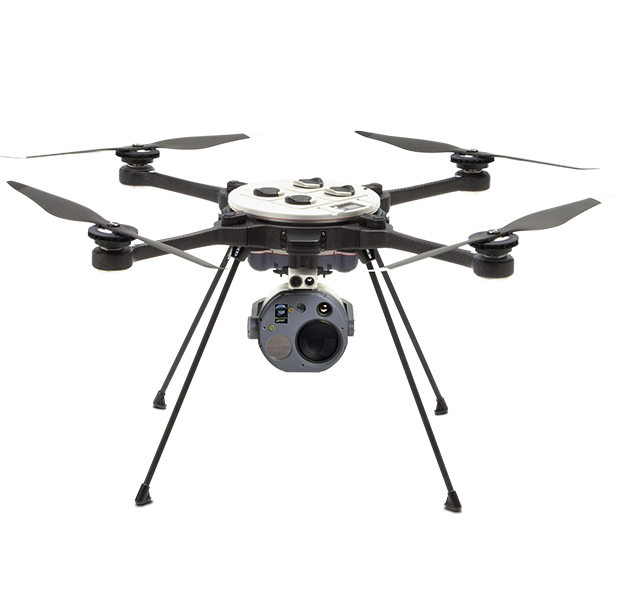
The SkyRanger R70 is a backpackable battery-electric quadcopter built by Teledyne FLIR in Waterloo, Ontario, carrying payloads of up to 3.5 kg through an open payload interface. It descends from the Aeryon Labs SkyRanger line and is in service with several government and defence operators.
Overview
The aircraft originated with Aeryon Labs, founded in 2007 in Waterloo, Ontario. FLIR Systems acquired Aeryon in January 2019 for US$200 million, and FLIR was itself absorbed into Teledyne in 2021, so the type is now marketed as a Teledyne FLIR product. Manufacturing remains in Waterloo. It is a current catalogue product.
Design and specifications
The R70 is a four-rotor aircraft with a carbon-fibre and magnesium airframe that folds for transport in a backpack and deploys without tools. Rotor-tip span and overall length are both given as 1.35 m, with an empty weight of 5 kg and a maximum take-off weight of 9 kg. Maximum speed is listed as 50 km/h and operating ceiling as 4,572 m, equivalent to the manufacturer's stated 15,000 ft above mean sea level. Environmental qualification is stated as IP-54 and MIL-STD-810G, with sustained wind tolerance of 65 km/h, gusts to 90 km/h and a 40 km/h limit for take-off.
Payload capacity is 3.5 kg through an open Payload Development Kit, which lets integrators fit their own sensors. Documented options include the StormCaster-T with a FLIR Boson long-wave infrared core and 75 mm continuous zoom, the StormCaster-L ultra-low-light 4K unit used for colour night imaging and mapping, and the MUVE B330 chemical and R430 radiological detection modules offered on the SkyRanger line. Teledyne FLIR documents onboard processing for object detection and classification, semi-autonomous flight, and operation where satellite navigation or communications are degraded.
Two commonly repeated figures are deliberately left empty in the data above. No manufacturer or trade source verified here publishes an endurance figure for the R70; a widely circulated 50-minute figure belongs to the earlier original SkyRanger, not this model. Range is similarly unpublished: one database lists 1,500 km, which is not plausible for a 9 kg electric quadcopter, while a 5 km figure that appears in trade coverage describes sensor detection distance rather than flight radius or datalink range.
Development and procurement history
In December 2018 the Royal Air Force trialled a SkyRanger for force protection at RAF Akrotiri, though the source does not specify the variant. In 2021 the Norwegian Coast Guard ran a three-year support tender valued at NOK 7.5 million covering six aircraft. In February 2024 Canada's Department of National Defence contracted Teledyne FLIR for more than 800 R70 systems worth CAD 95 million for donation to Ukraine, with deliveries beginning in mid-2024; a later report describes 450 units delivered that summer. The contract bundles aircraft, payloads and support, so it does not give a clean unit price, and none is published.
Reporting on a United States Army Short Range Reconnaissance selection was not confirmed on any source checked here, and no NDAA, Blue UAS or Defense Innovation Unit determination specific to the R70 was found.
Operators
Documented operators are Australia, New Zealand and Norway, through the Norwegian Coast Guard, together with Canada as the procuring government and Ukraine as the recipient of the 2024 Canadian donation.
Frequently asked questions
Who makes the SkyRanger R70?
Teledyne FLIR, at Waterloo, Ontario. The design came from Aeryon Labs, which FLIR Systems bought in January 2019 for US$200 million.
How long does the SkyRanger R70 fly?
No endurance figure is published by the manufacturer or on the trade sources checked here. A frequently quoted 50 minutes belongs to the earlier original SkyRanger rather than the R70.
What payloads does it carry?
Up to 3.5 kg through an open Payload Development Kit. Documented options include StormCaster-T thermal, StormCaster-L low-light 4K, and MUVE chemical and radiological detectors.
Who operates the SkyRanger R70?
Australia, New Zealand and the Norwegian Coast Guard, with Canada procuring more than 800 systems in 2024 for donation to Ukraine.
How high can it fly?
Teledyne FLIR gives an operating ceiling of 15,000 ft above mean sea level, about 4,572 m.
Is the SkyRanger R70 NDAA-compliant?
No source checked here states an NDAA, Blue UAS or Defense Innovation Unit determination specific to this model.