RQ-4 Global Hawk
Northrop Grumman · United States · also known as Global Hawk (RQ-4), Global Hawk, RQ-4B, RQ4, グローバルホーク · Updated
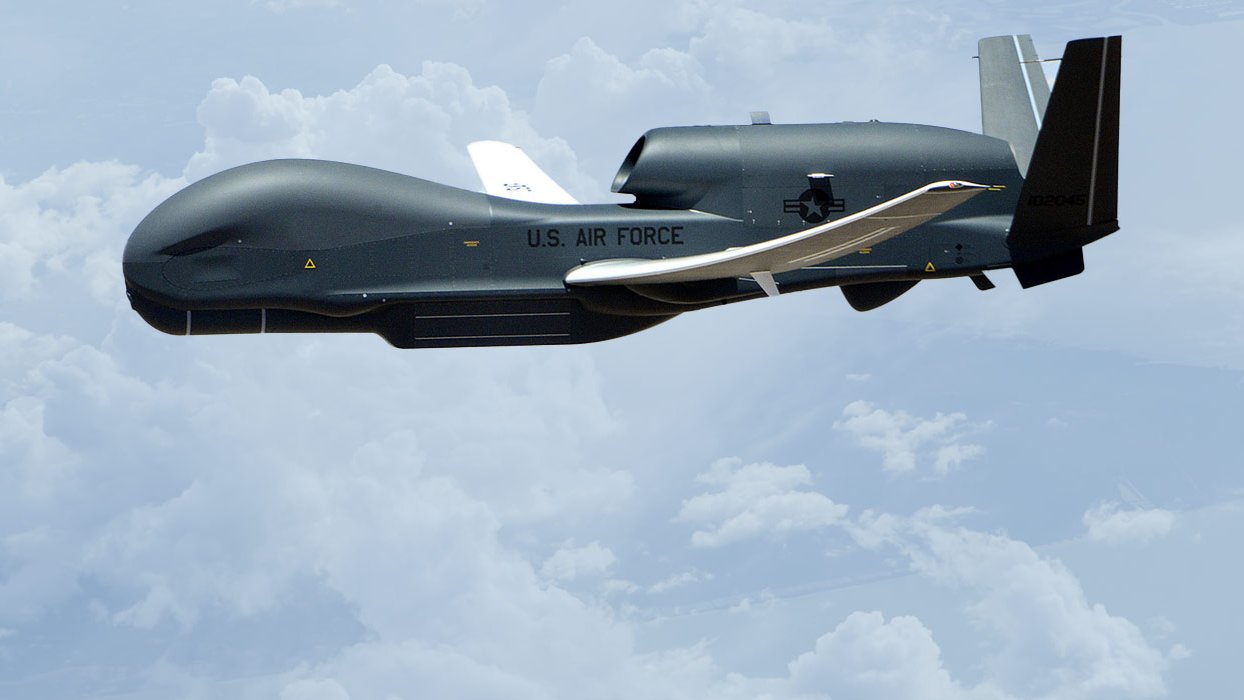
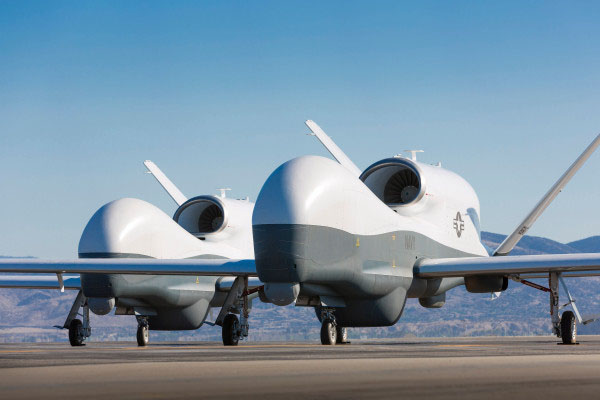
The RQ-4 Global Hawk is a high-altitude, long-endurance (HALE) unmanned aircraft system built by Northrop Grumman of the United States, first flown on 28 February 1998. It is designed to gather persistent, high-resolution intelligence, surveillance and reconnaissance (ISR) imagery over large areas in all weather, day or night.
Overview
Global Hawk was developed under DARPA's Tier II+ High-Altitude Endurance UAV programme by Ryan Aeronautical, later absorbed into Northrop Grumman. The U.S. Air Force has operated the type since it reached initial operational use in November 2001, flying missions in support of operations in Iraq, Afghanistan, North Africa and the wider Asia-Pacific region. Beyond its primary ISR role, a portion of the fleet has also carried the Battlefield Airborne Communications Node (BACN) payload to relay communications for forces on the ground.
The programme has produced several variants, including the original RQ-4A, the larger RQ-4B with an extended wingspan and heavier payload, and the NATO-operated RQ-4D Phoenix based at Sigonella, Italy. A German programme to acquire the type as the RQ-4E "Euro Hawk" was cancelled in 2013 before entering service, after certification costs proved prohibitive; only one airframe was delivered to Germany, and it now sits in a museum rather than in operational use.
Design and capabilities
The aircraft has a length of about 14.5 m and a wingspan of roughly 39.9 m, with a maximum take-off weight near 14,628 kg and a sensor payload of about 1,360 kg. A single Rolls-Royce F137-RR-100 turbofan, rated at 7,600 lbf of thrust, gives Global Hawk an endurance of more than 34 hours, a typical cruise speed around 574 km/h, a ferry range of roughly 22,800 km and a service ceiling of about 18,288 m (60,000 ft). Northrop Grumman has stated that the worldwide Global Hawk fleet has logged more than 320,000 cumulative flight hours.
Operational history
The U.S. Air Force is Global Hawk's primary operator, flying it from bases including Beale AFB, Grand Forks AFB and Andersen AFB, Guam, as well as NAS Sigonella in Italy. NATO operates a small fleet of RQ-4D Phoenix aircraft under its Alliance Ground Surveillance programme, based at Sigonella. Japan's Air Self-Defense Force and the Republic of Korea Air Force also operate the RQ-4B, and NASA has flown Global Hawk airframes for atmospheric and earth-science research, including support for disaster response after Japan's 2011 Tōhoku earthquake and tsunami.
Service with Japan
Japan's Acquisition, Technology & Logistics Agency signed a contract with the U.S. Department of the Air Force on 28 June 2018 for three RQ-4B Block 30i aircraft and two ground control stations. The first Japanese aircraft left Palmdale, California, on 10 March 2022 and arrived at Misawa Air Base in Aomori Prefecture on 12 March 2022 after an 18.7-hour ferry flight, according to Northrop Grumman as reported by Army Recognition. The Japan Air Self-Defense Force formed its Reconnaissance Air Group at Misawa on 15 December 2022 to operate the type, and as of September 2026 the JASDF says it holds three Global Hawks, all assigned to Misawa.
On 15 September 2026 the JASDF announced that one of its RQ-4Bs had lost communications shortly before 13:00 local time about 50 km north of the coast of Tottori Prefecture, over international waters, and was missing. The Japan Coast Guard reported sighting what appeared to be aircraft debris on the sea off Tottori; no damage to ships had been reported. The JASDF said it was the first time one of its Global Hawks had gone missing. Nikkei reported the incident the same day; the cause had not been announced as of that date.
Frequently asked questions
What is the range of the RQ-4 Global Hawk?
Its ferry range is about 22,800 km (12,300 nautical miles), reflecting its role as a high-altitude, long-endurance platform rather than a short-radius tactical drone.
How long can the RQ-4 Global Hawk fly?
The aircraft has a stated endurance of more than 34 hours, with a recorded single-flight endurance of 34.3 hours.
Who makes the RQ-4 Global Hawk?
It is built by Northrop Grumman, based on a design originally developed by Ryan Aeronautical under a DARPA programme.
Which countries operate the RQ-4 Global Hawk?
Confirmed operators include the U.S. Air Force, NATO (as the RQ-4D Phoenix), Japan and South Korea; a German acquisition programme was cancelled before entering service.
How much does an RQ-4 Global Hawk cost?
Wikipedia cites a flyaway figure of roughly 131.4 million US dollars in 2013 pricing, up from about 10 million US dollars per aircraft when the programme began in 1994.
Does Japan operate the RQ-4 Global Hawk?
Yes. The Japan Air Self-Defense Force operates the RQ-4B Block 30i from Misawa Air Base; it ordered three aircraft in 2018 and received the first in March 2022. One JASDF aircraft lost contact off Tottori Prefecture on 15 September 2026.
What is the RQ-4 Global Hawk used for?
It performs persistent, high-altitude intelligence, surveillance and reconnaissance, and some airframes have also relayed battlefield communications.
SourcesChecked
- RQ-4 Global Hawk — U.S. Air Force fact sheet
- Northrop Grumman RQ-4 Global Hawk — Wikipedia
- Global Hawk — Northrop Grumman
- RQ-4 (航空機) — Wikipedia (Japanese)
- Northrop Grumman completes ferry flight of Japanese RQ-4B Global Hawk — Army Recognition (2022)
- 航空自衛隊の無人偵察機「グローバルホーク」通信途絶える 鳥取沖 — Nikkei (2026-09-15)