DJI Mini series
DJI · China · also known as DJI Mini 5 Pro, DJI Mini 4 Pro, DJI Mini 3 Pro, DJI Mini 3, DJI Mini 2, Mavic Mini · Updated
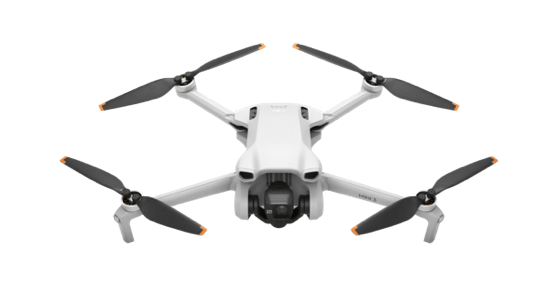
The DJI Mini series is DJI's line of folding consumer camera drones designed to weigh less than 250 g at take-off, the threshold below which many countries (including the United States, the EU and Japan for aircraft under 100 g) apply lighter registration or licensing rules. The line began with the Mavic Mini in 2019 and, with the Mini 4 Pro announced on 25 September 2023, combined a 48 MP 1/1.3-inch camera, omnidirectional obstacle sensing and up to 45 minutes of flight time in an aircraft that fits in a jacket pocket. DJI's newest model, the Mini 5 Pro, launched on 17 September 2025 with a larger 1-inch sensor and LiDAR-assisted obstacle sensing; it is described in the Variants section below. The specifications on this page refer to the Mini 4 Pro unless stated otherwise.
Overview
DJI, headquartered in Shenzhen, China, is the world's largest maker of consumer drones. The Mini series was created to give beginners and travellers a camera drone light enough to escape the strictest regulatory categories while keeping the folding design and flight software of the larger Mavic and Air lines. Successive generations have added a 4K camera (Mini 2, 2020), a larger sensor and tri-directional obstacle sensing (Mini 3 Pro, 2022), a lower-cost Mini 3 (2022), and omnidirectional obstacle sensing with DJI's O4 transmission system (Mini 4 Pro, 2023).
Design and capabilities
The Mini 4 Pro has a take-off weight of under 249 g with the standard battery. Folded it measures 148 × 94 × 64 mm; unfolded it is 298 × 373 × 101 mm. Four brushless electric motors give a maximum horizontal speed of 16 m/s (about 57.6 km/h) in Sport mode, ascent and descent rates of up to 5 m/s, and wind resistance of 10.7 m/s. DJI quotes a maximum service ceiling of 4,000 m above sea level with the standard battery.
Flight time is 34 minutes with the standard Intelligent Flight Battery or 45 minutes with the heavier Intelligent Flight Battery Plus (which takes the aircraft over 250 g in most markets). Maximum flight distance on a full charge is 18 km (standard) or 25 km (Plus). The O4 video transmission system supports a maximum control range of 20 km under FCC rules and 10 km under CE and SRRC rules, with 1080p live view.
The camera uses a 1/1.3-inch CMOS sensor with 48 MP effective resolution on a three-axis mechanical gimbal that can rotate for true vertical shooting. Video is recorded at up to 4K (3840 × 2160) at 24–60 fps, with 4K/100 fps slow motion, HDR modes and the D-Log M colour profile. Obstacle sensing is provided by an omnidirectional binocular vision system supplemented by a 3D infrared sensor, enabling Advanced Pilot Assistance and ActiveTrack 360 subject tracking. Internal storage is 2 GB, expandable by microSD.
Use cases
The Mini series is aimed at travel and hobby photography, social-media video and first-time pilots. Its sub-250 g weight means that in the United States recreational flyers need not register the aircraft (though FAA rules and Remote ID requirements for other categories still apply), and in the European Union it falls into the C0 class with the fewest restrictions. In Japan, aircraft of 100 g or more must be registered with the Ministry of Land, Infrastructure, Transport and Tourism, so Mini-series drones are registered there like other consumer drones.
Variants
- Mavic Mini (2019) – 2.7K camera, first sub-250 g DJI drone.
- Mini 2 (2020) – 4K camera, OcuSync 2.0 transmission; later refreshed as Mini 2 SE.
- Mini 3 Pro (2022) – 1/1.3-inch sensor, tri-directional obstacle sensing, vertical shooting.
- Mini 3 (2022) – lower-cost version without obstacle sensing.
- Mini 4 Pro (2023) – omnidirectional obstacle sensing, O4 transmission, 4K/100 fps; launched at US$759 with the RC-N2 controller, US$959 with the RC 2 and US$1,099 for the Fly More Combo.
- Mini 5 Pro (2025) – DJI's newest Mini, launched 17 September 2025 at 249.9 g (±4 g) with a 1-inch 50 MP sensor, the first Mini-series camera drone with a sensor that size. Flight time is 36 minutes on the standard Intelligent Flight Battery or 52 minutes on the Intelligent Flight Battery Plus (not sold in the EU), using an upgraded O4+ transmission system. It adds forward LiDAR to its obstacle-sensing system, which DJI and reviewers report improves obstacle detection and return-to-home navigation in low light. It launched at US$759 for the base aircraft, with Fly More Combo bundles at US$959 (RC-N3 controller) and US$1,099 (RC 2 controller) — the same price points as the Mini 4 Pro's launch. DJI did not release it in the United States at launch; it later reached US retail, and by August 2026 it was reported to be legally on sale and in the hands of thousands of US customers.
Frequently asked questions
How long can a DJI Mini 4 Pro fly?
Up to 34 minutes with the standard battery or 45 minutes with the Intelligent Flight Battery Plus, according to DJI.
What is the range of the DJI Mini 4 Pro?
The O4 transmission system is rated at 20 km (FCC) or 10 km (CE/SRRC); the maximum flight distance on one battery is 18–25 km. Local regulations generally require keeping the aircraft within visual line of sight.
Does the DJI Mini need to be registered?
Under 250 g it is exempt from registration for recreational use in the United States and falls into the EU's C0 class, but Japan requires registration of any drone weighing 100 g or more. Always check current local rules.
How much does the DJI Mini 4 Pro cost?
It launched at US$759 for the base kit with the RC-N2 controller; the RC 2 kit was US$959 and the Fly More Combo US$1,099.
What is the difference between Mini 4 Pro and Mini 3 Pro?
The Mini 4 Pro adds omnidirectional obstacle sensing (the Mini 3 Pro sensed in three directions), the longer-range O4 transmission system, 4K/100 fps recording, the D-Log M colour profile and ActiveTrack 360.
What is different about the DJI Mini 5 Pro?
Launched 17 September 2025, it is the first Mini-series drone with a 1-inch, 50 MP sensor (up from 1/1.3-inch on the Mini 4 Pro), and it adds forward LiDAR to its obstacle-sensing system. Flight time is 36 minutes on the standard battery or 52 minutes on the Intelligent Flight Battery Plus.