Mirach 100/5
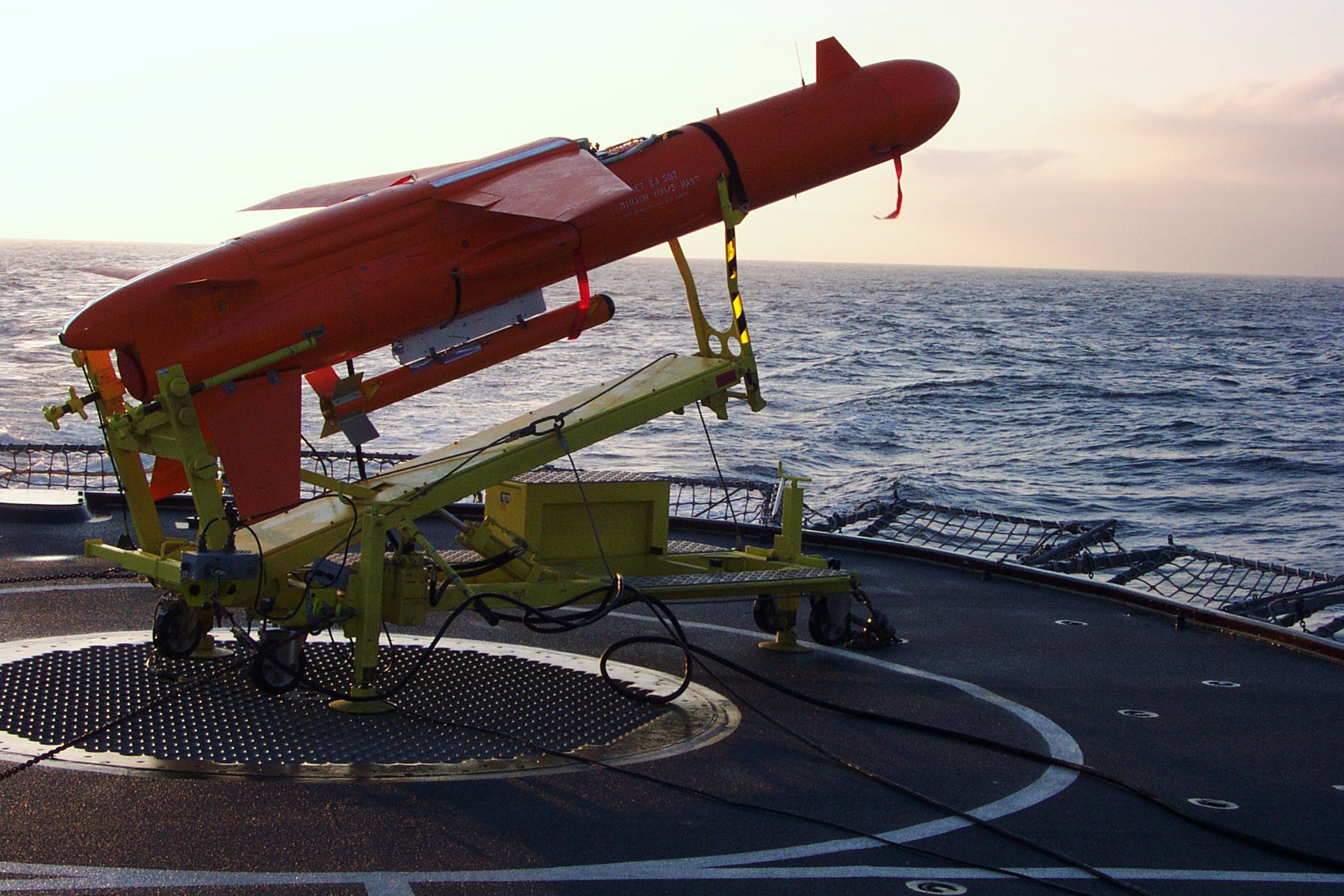
Mirach 100/5 is a subsonic aerial target drone developed by Leonardo of Italy, first flown in December 1996 and certified by the Italian armed forces in 1998. It is a reusable, multi-role threat simulator used by European and allied air forces and navies to train radar operators and qualify air-defence and air-to-air weapon systems against realistic target profiles.
Overview
Mirach 100/5 is the latest in Leonardo's Mirach 100-series of aerial targets, which began with the Mirach 100/2 in 1984 and continued through the 100/3 "Mizar" and the 100/4, in service from 1989. Leonardo describes it as the standard threat simulator for European armed forces, capable of managing up to eight simulated targets in a single training scenario and reproducing the kinematics and signatures of sea-skimming anti-ship missiles, fighter and strike aircraft, cruise missiles and fast UAS. Leonardo says more than 2,000 Mirach 100/5 missile-engagement launches have been carried out, and that the system has been used to validate the Italian Army's SAMP/T, the Italian Navy's PAAMS with Aster missiles, and AMRAAM and IRIS-T air-to-air missiles for the Italian Air Force, among other programmes. Leonardo also operates Mirach 100/5 targets on a turnkey basis at the Salto di Quirra training range in Sardinia under long-running service contracts for the Italian Army.
In January 2022 Leonardo announced an upgraded Mirach 100/5 V2, with a new engine and avionics intended to improve reliability and remove parts obsolescence from the original design, and secured its first order for 10 V2 drones plus a ground control station, training, spares and support, for an undisclosed international customer. Leonardo also sells the system on a drones-as-a-service basis, in which it owns and operates the fleet on the customer's behalf, as it does for the Italian Air Force.
Design and capabilities
Mirach 100/5 is 4.07 m long with a 2.3 m wingspan, a 0.4 m fuselage diameter and a maximum take-off weight of 330 kg. It is launched using two jet-assisted take-off (JATO) rocket boosters, giving it a full day/night, adverse-weather launch capability from fixed ground ranges or mobile facilities, including ships. The aircraft reaches a subsonic top speed of up to 250 m/s (about 900 km/h) and can operate between 3 m above the sea (10 m in sea state 3) and 12,000 m altitude, tolerating instantaneous manoeuvre loads of 8 g and sustained loads of 6 g. Endurance is about 90 minutes, and the aircraft carries up to 70 kg of payload internally or under the wings, drawn from options including radar cross-section augmentation (Luneburg lens, active X-band amplifiers), infrared augmentation (tracking flares, hot-nose emitters), chaff and flare countermeasures dispensers, smoke cartridges, a radar miss-distance indicator scoring system, and a radar-threat (RF seeker) simulator; it can also tow up to two secondary targets. A differential-GPS-guided Ground Control Station handles mission planning, re-tasking, rehearsal and playback, and Leonardo quotes ground turnaround of under an hour and sea-recovery turnaround of under three hours between sorties.
Leonardo's smaller Mirach 40, in service since 2018, shares the Mirach 100/5's ground control station and offers most of its performance at lower cost using a pneumatic-catapult launch rather than JATO boosters.
Operational history
Leonardo says sixteen armed forces have trained with the Mirach 100/5 since its 1998 certification, naming Belgium, Denmark, France, Germany, Greece, Italy, Spain and the United Kingdom among them, alongside the Italian armed forces that use it as their principal in-service target drone. Since 2010 Leonardo has also been developing the Mirach 100/X, a planned supersonic, stealth-shaped successor aerial target, separate from the current in-production Mirach 100/5 and Mirach 100/5 V2.
Frequently asked questions
What is the Mirach 100/5 used for?
It is an aerial target drone: armed forces launch it to simulate hostile aircraft and missiles so they can test and train air-defence radars and weapons, including surface-to-air and air-to-air missile systems, against a realistic, manoeuvring target.
How fast is the Mirach 100/5?
Leonardo quotes a subsonic top speed of up to 250 m/s, about 900 km/h.
How is the Mirach 100/5 launched?
From two jet-assisted take-off (JATO) rocket boosters, allowing launch from fixed ground ranges or mobile facilities such as ships, in day, night or adverse weather.
Who uses the Mirach 100/5?
Leonardo says sixteen armed forces have trained with it, including those of Italy, Belgium, Denmark, France, Germany, Greece, Spain and the United Kingdom.
How long can the Mirach 100/5 fly?
About 90 minutes, carrying up to 70 kg of payload such as radar or infrared threat-simulation equipment.