V-BAT
Shield AI · United States · also known as V Bat, V-BAT 128, MQ-35A · Updated
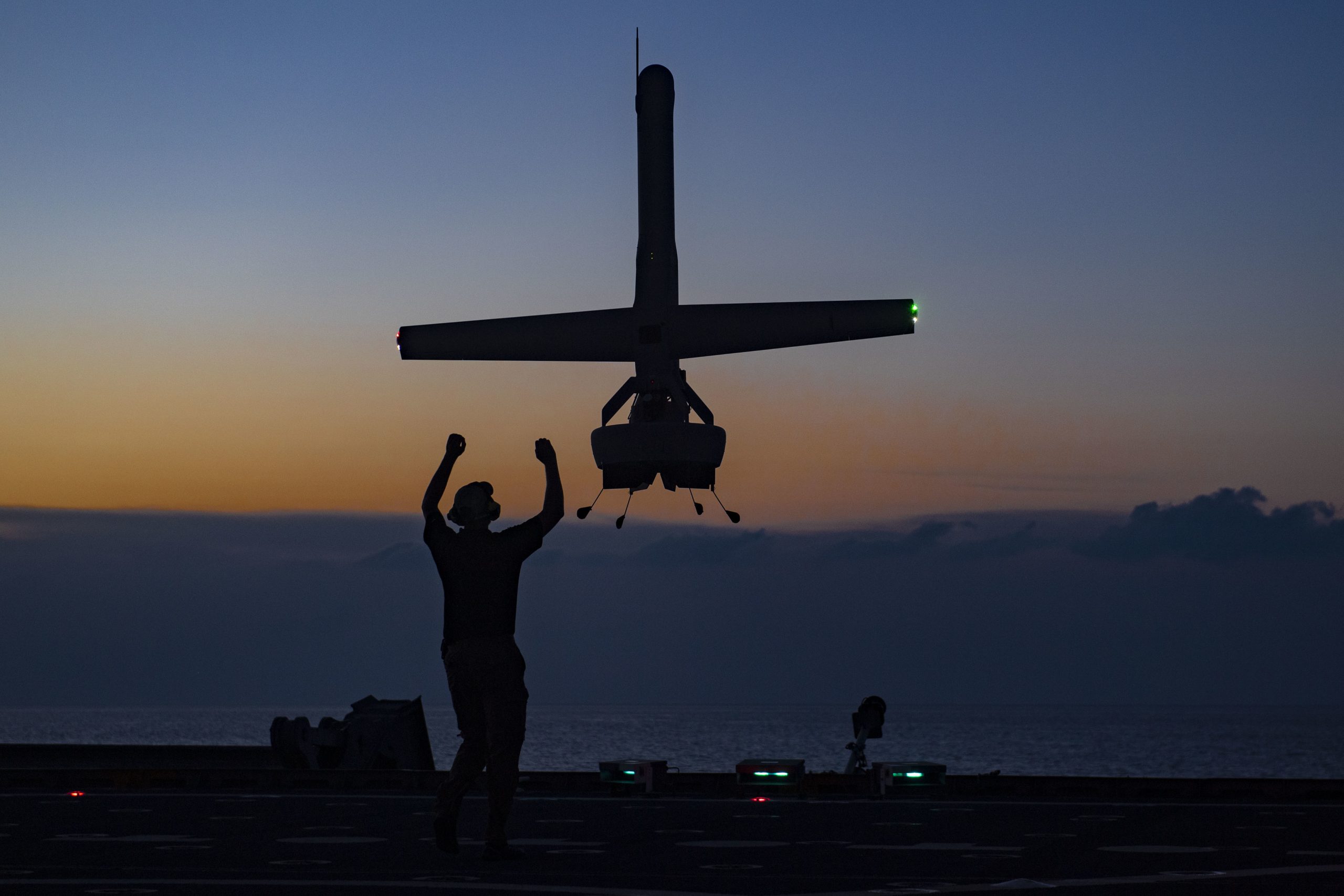
The V-BAT, also designated MQ-35A, is a vertical take-off and landing (VTOL) tactical drone developed by Shield AI, built around a single ducted-fan engine in a tail-sitter airframe that launches and lands without a runway, catapult or recovery net. It is in service with the United States Navy, Coast Guard and Marine Corps, and has been adopted by a growing number of allied militaries, including Ukraine.
Design and capabilities
The V-BAT takes off and lands vertically, balanced on its tail, then transitions to forward flight once the ducted fan has built up airspeed over its fixed wing. This tail-sitter layout removes the need for a catapult, net or runway, and lets the aircraft operate from small ships and confined sites. Shield AI gives a length of 3.8 m and a maximum take-off weight of about 75 kg, with the current production version carrying up to 18.1 kg of payload and flying for 12 or more hours on a single-engine heavy-fuel (JP-5) powerplant. Published range figures run from about 130 km with the standard MPU5 radio to about 180 km using a C-band radio link. A 2025 Block 5.3 upgrade replaced the original gasoline engine with the heavier-fuel engine, enlarged the fuel tanks, raised maximum payload from 25 to 40 lb (about 11.3 to 18.1 kg), and added satellite communications and unassisted vertical launch and landing.
Sensor payloads include electro-optical/infrared cameras, Shield AI's ViDAR wide-area optical search sensor, and a synthetic aperture radar option, with a laser target designator and laser range finder for targeting support. The aircraft runs on Shield AI's Hivemind autonomy software, which the company has demonstrated flying V-BATs in coordinated swarms.
Operational history
Originally developed by Martin UAV, the V-BAT airframe was acquired by Shield AI in 2021. The United States Navy began prototyping the aircraft in 2021, and it has since been selected for the US Army's Future Tactical UAS programme and added to the Department of Defense's Blue UAS Cleared List. In December 2022 a V-BAT carried out the Navy's first unmanned cargo delivery to a ship underway at sea.
Export customers in service include Colombia's Navy, Greece's Army, Indonesia's Kopassus special forces, Japan's Maritime Self-Defense Force, the Royal Netherlands Navy, and Romania's Naval Forces. Ukraine's Unmanned Systems Forces also operate the V-BAT. Several more countries, including Argentina, India, Poland and Taiwan, have placed orders or signed agreements for future delivery. Shield AI also builds the X-BAT, a much larger fighter-class VTOL aircraft unveiled in October 2025; it is not a variant of the V-BAT airframe.
Frequently asked questions
What is the range of the V-BAT?
Shield AI publishes roughly 130 km with its standard radio and up to about 180 km with a C-band radio link.
Does the V-BAT need a runway?
No. It takes off and lands vertically on its tail, so it can operate from small ships and sites without a runway, catapult or recovery net.
Who operates the V-BAT?
The US Navy, Coast Guard and Marine Corps fly it, alongside militaries including Colombia, Greece, Indonesia, Japan, the Netherlands, Romania and Ukraine.
How long can it stay airborne?
Shield AI states 12 or more hours of endurance with an electro-optical/infrared payload.