Alpha 900
Alpha Unmanned Systems · Spain · Updated
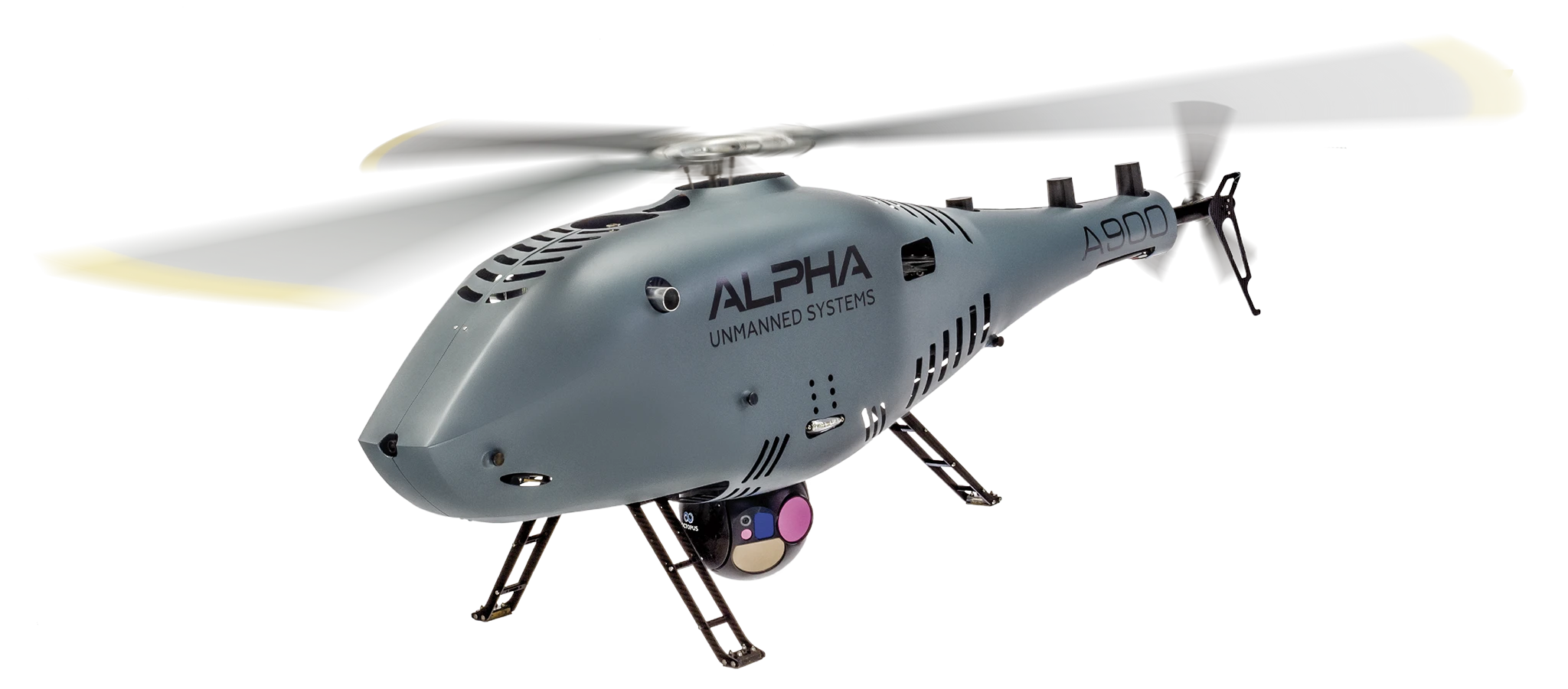
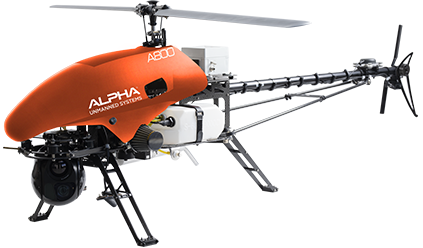
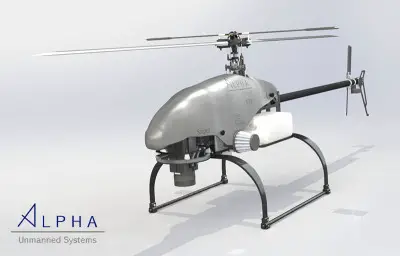
Alpha 900 is a maritime-capable helicopter unmanned aerial vehicle developed by Alpha Unmanned Systems of Spain, first flown in 2019.
Overview
The Alpha 900 is a single-rotor helicopter UAV designed for maritime intelligence, surveillance and reconnaissance (ISR), border control and target-acquisition duties. Alpha Unmanned Systems developed the type from 2019 as a larger, longer-endurance complement to its Alpha 800, built to comply with NATO's STANAG 4738 standard for tactical UAV operations. By 2023 the aircraft had achieved military airworthiness recognition in Spain and Germany.
The Alpha 900 has since been selected by several government and defense customers. Rapid Expeditionary Concepts, a US-based systems integrator, announced a contract in April 2023 to integrate and deploy the Alpha 900 for a US Department of Defense operational evaluation, including a counter-UAS electro-optical sensor package. Indonesia's Army Artillery Center trialed the aircraft for target detection and coastal-defense applications in March 2024, alongside the Indonesian Coast Guard and national maritime security agency BAKAMLA. In September 2026, Spain's Navy selected at least three A900 systems in maritime configuration for its Unmanned Vehicle Experimentation Centre (CEVENTA), following flight testing with the Spanish Navy since 2022 and manned-unmanned teaming trials with Airbus Helicopters España in May 2026.
Design and capabilities
The Alpha 900 has a maximum takeoff weight of less than 25 kg and carries a payload of up to 4 kg across internal and external payload bays, with an onboard generator supplying up to 150 W for sensors and other active equipment. Propulsion is a heavy-fuel piston engine, marketed by Alpha Unmanned Systems under a low-vibration "Boxer" design, compatible with Jet A1, JP5 and JP8 fuel. The manufacturer states an endurance of up to 4 hours and a maximum speed of 100 km/h, with a cruise speed of around 60 km/h. Alpha Unmanned Systems lists an operational range of up to 200 km; a September 2026 Spanish Navy procurement in maritime configuration was separately documented with an operational range of up to 60 km.
The aircraft is built for vessel-based operations, with automatic vertical takeoff and landing from moving ships, sea-state tolerance reported at Beaufort 4 to 5, and navigation intended to keep functioning in GPS-denied environments using a laser altimeter and backup sensors. Standard payloads include EO/IR cameras with tracking and geo-referencing; the airframe is rated to at least IP64 and EMI-shielded, with redundant power supplies and an automatic autorotation mode for engine-out landings. Alpha Unmanned Systems also offers emergency flotation-device payloads for search-and-rescue missions.
Operational history
Government and military customers documented for the Alpha 900 include the U.S. Department of Defense, the Hellenic Navy, the Indonesian Coast Guard, Bulgaria's Border Police, Georgia's defense forces, the European Border and Coast Guard Agency (FRONTEX), and Spain's Navy. Spain's Navy has tested the type since 2022, including participation in NATO exercises and integration into patrol-vessel combat systems, ahead of its September 2026 CEVENTA procurement of at least three maritime-configuration aircraft with vessel-based and terrestrial control stations, a flight simulator and AIS transceiver modules.
Variants
Alpha Unmanned Systems also markets an A900T target-drone variant of the airframe. The Alpha 900 is the larger, STANAG-compliant counterpart to the manufacturer's Alpha 800 helicopter UAV, sharing the same general single-rotor, carbon-fiber design lineage that traces back to the earlier Sniper helicopter UAV.
Frequently asked questions
When was the Alpha 900 introduced?
Alpha Unmanned Systems developed the Alpha 900 starting in 2019 as a STANAG 4738-compliant maritime platform.
What is the Alpha 900's maximum takeoff weight?
The manufacturer states a maximum takeoff weight of less than 25 kg.
How far can the Alpha 900 fly?
Alpha Unmanned Systems lists an operational range of up to 200 km, though a September 2026 Spanish Navy maritime configuration was documented with an operational range of up to 60 km.
Which countries use the Alpha 900?
Documented customers include the United States, Spain, Greece, Indonesia, Bulgaria and Georgia, along with the European agency FRONTEX.
What engine powers the Alpha 900?
It uses a heavy-fuel piston engine compatible with Jet A1, JP5 and JP8 fuel.
How long can the Alpha 900 stay airborne?
The manufacturer states an endurance of up to 4 hours.
SourcesChecked
- A900 Unmanned Tactical Helicopter
- Alpha A900 Helicopter UAV
- Spanish Armada Selects Alpha Unmanned Systems for Tactical UAVs & Maritime Surveillance
- Company - Alpha Unmanned Systems
- Alpha 900 Unmanned Helicopters for US Government
- Indonesia tests Spanish Alpha A900 helicopter UAV for artillery and coastal defense