Intermediate eXperimental Vehicle (IXV)
Thales · European Union · Space · also known as IXV, ESA IXV, Intermediate Experimental Vehicle · Updated
The Intermediate eXperimental Vehicle (IXV) is an uncrewed European lifting-body re-entry demonstrator flown by the European Space Agency, with Thales Alenia Space as prime contractor. It made a single flight on 11 February 2015, launched on a Vega rocket from the Guiana Space Centre, and is now retired: the vehicle was recovered from the Pacific Ocean and never flew again.
Design and capabilities
IXV measures about 5 metres long, 2.2 metres across and 1.5 metres high, with a gross mass of roughly 1,900 kg, a size set by what the Vega launcher could lift. It has no wings at all. The fuselage itself generates lift, giving a lift-to-drag ratio of about 0.7 during re-entry, which is enough for the vehicle to steer rather than simply fall along a ballistic path. Control comes from a pair of movable flaps at the rear working together with reaction-control thrusters across the whole flight regime, including at hypersonic speed.
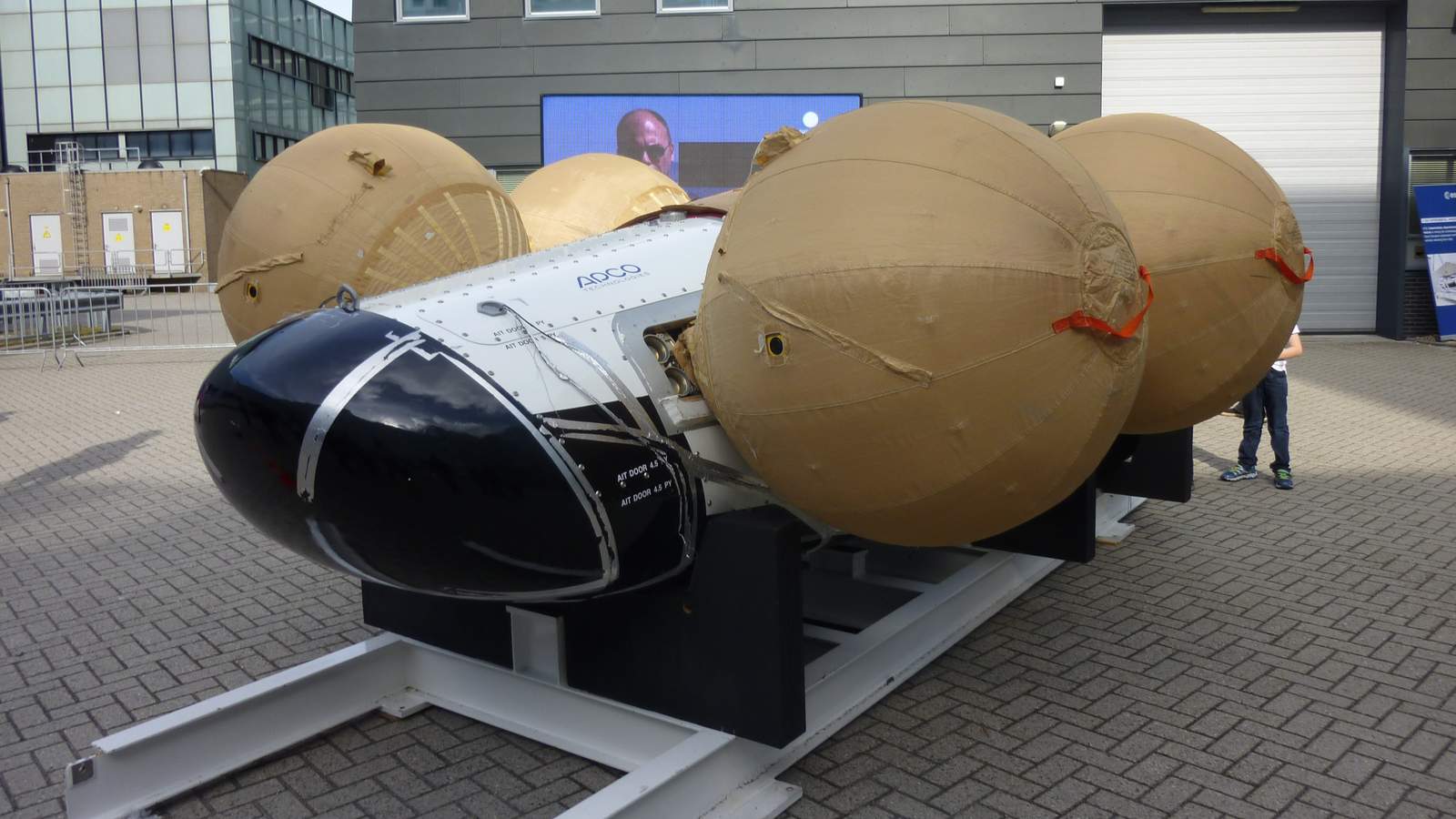
Thermal protection is split by surface. The underside, which takes the worst heating, carries ceramic panels made from a carbon-fibre and silicon-carbide blend fixed directly to the structure, while the upper surfaces are coated with an ablative cork and silicone composite. The avionics are built around a LEON2-FT microprocessor linked by a MIL-STD-1553B serial bus. Recovery is by parachute, with flotation balloons and airbags deployed shortly before the vehicle reaches the water. A drop test from 3 km altitude in 2013 validated that subsonic parachute, flotation and beacon sequence before the flight from orbital speed.
Programme status
The project began in early 2005 under an Italian programme called PRIDE, run by the Italian Space Agency and the Italian Aerospace Research Centre. By November 2006 eleven ESA member states were backing it: Austria, Belgium, France, Germany, Ireland, Italy, Portugal, Spain, Sweden, Switzerland and the Netherlands, with Italy as the principal funder. ESA contracted Thales Alenia Space in December 2009 for an 18-month preliminary phase, and the company remained prime contractor through to flight.
The flight took place on 11 February 2015, lifting off at 13:40 UTC on Vega mission VV04. IXV separated at an altitude of 333 km, coasted to an apogee of 412 km, and began controlled atmospheric re-entry at 120 km travelling at about 7.5 km per second. It glided roughly 7,500 km before descending under parachute and landing intact on the surface of the Pacific Ocean west of the Galapagos Islands, where the recovery ship Nos Aries collected it. The mission lasted about 100 minutes, and IXV became the first lifting body to fly a full atmospheric re-entry from orbital speed.
No second IXV was built. The technology fed into Space Rider, ESA's reusable orbital platform, for which Thales Alenia Space is responsible for the re-entry module. ESA approved funding for that work in November 2017, and the first Space Rider flight is planned for 2028.
FAQ
Is it flying today? No. IXV flew once, in February 2015, and the programme is closed. Its successor, Space Rider, is still in testing.
How many people does it carry? None. IXV is uncrewed and flew entirely under automatic control, from separation through re-entry to splashdown.