Shahed-136
Shahed Aviation Industries · Iran · also known as Shahed 136, HESA Shahed 136, Geran-2, Герань-2, 天竺葵-2, シャヘド136, Shahed136 · Updated
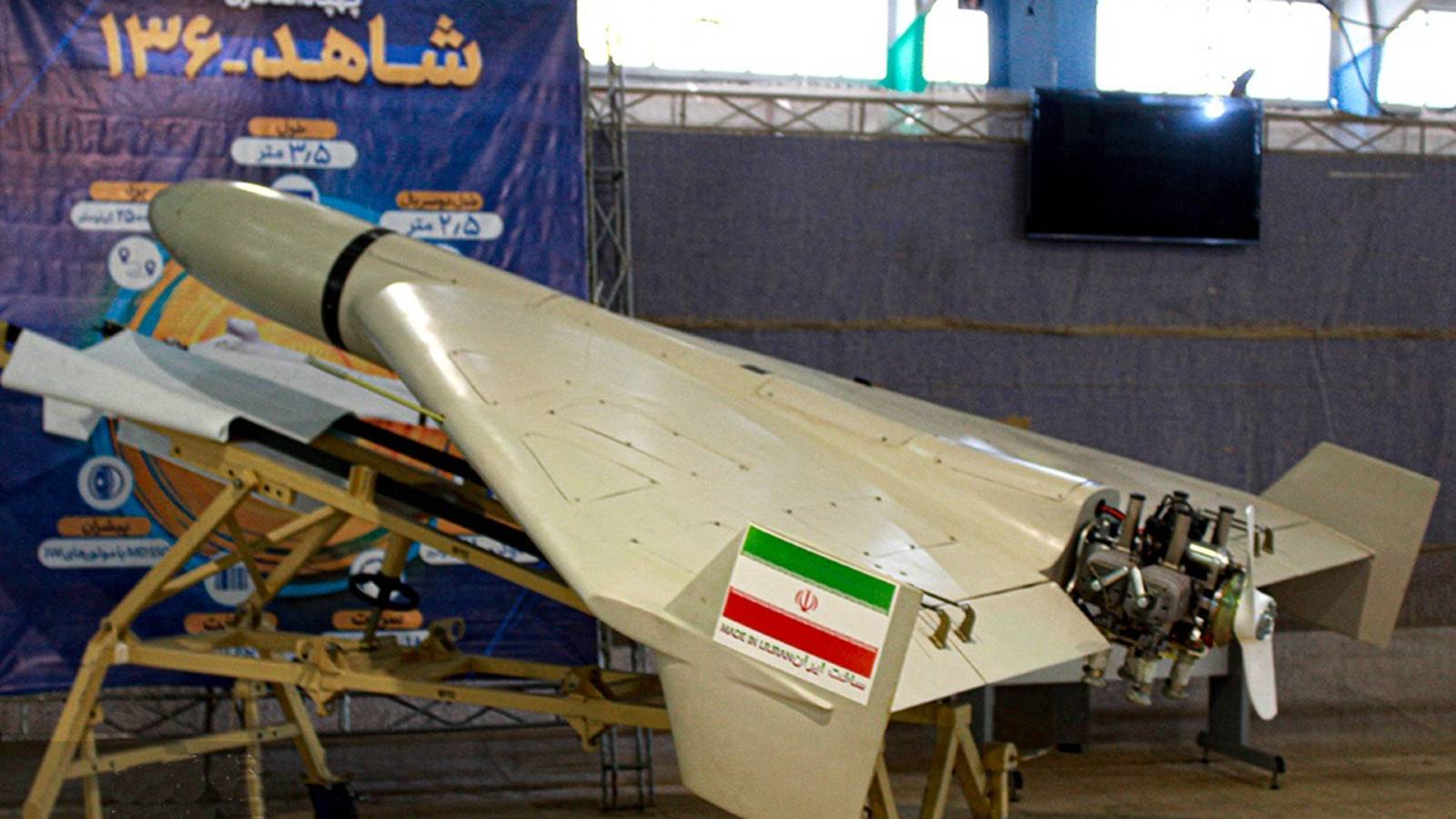
Shahed-136 is a delta-wing loitering munition developed by Shahed Aviation Industries of Iran, first shown publicly in late 2021 and in Iranian service from around that year; Russia has produced a licensed and locally modified version, designated Geran-2, since 2022, and it is that Russian-built version that has seen by far the largest operational use.
Overview
The Shahed-136 is a one-way attack drone, sometimes called a "kamikaze drone": rather than returning to base, it flies a pre-programmed route to a target and detonates its warhead on impact. It is produced by Shahed Aviation Industries, an Iranian aerospace organisation linked to the Islamic Revolutionary Guard Corps Aerospace Force and to Iran Aircraft Manufacturing Industrial Company (HESA); the European Union, United States and Canada sanctioned Shahed Aviation Industries in late 2022 for supplying drones used in Russia's war against Ukraine.
Iran has supplied Shahed-136 airframes and components to Russia since 2022. Russia assembles and increasingly manufactures its own version, the Geran-2 ("geranium" in Russian), primarily at the Alabuga Special Economic Zone in Tatarstan, according to CSIS and other trade-press reporting. Russian production has grown from imported Iranian kits to substitution of many components with Russian- and Chinese-sourced parts.
The type's low unit cost relative to a cruise missile, and Russia's practice of launching them in large numbers alongside decoys, has made it one of the most-discussed weapons of the war in Ukraine and the starting point for a family of faster, jet-powered successors — Geran-3, Geran-4 and Geran-5 — built to defeat cheap propeller-driven interceptor drones that began downing large numbers of Geran-2s from 2025.
Design and capabilities
The airframe is 3.5 m long with a 2.5 m wingspan and a launch weight of about 200 kg, according to Wikipedia, GlobalSecurity.org and Army Technology. It is powered by a Mado MD-550 piston engine — reported to be a reverse-engineered copy of the German Limbach L550E — driving a rear-mounted pusher propeller, and takes off with rocket-assisted (JATO) boosters from a launch canister that also serves as its transport container. GlobalSecurity.org lists a cruise/maximum speed of around 185 km/h and an operating altitude of roughly 1,000 m.
The warhead is generally reported at around 50 kg on the Iranian baseline (Wikipedia, GlobalSecurity.org), though Army Technology gives a figure of up to 40 kg and Wikipedia notes that Russian-built Geran-2s produced from 2024 onward carry a larger, roughly 90 kg warhead in some configurations, trading range for effect. Reported range varies widely by source and by warhead fit: Wikipedia's higher-end figure is 2,500 km, falling to about 650 km with the heavier 90 kg warhead, while other assessments cited by GlobalSecurity.org put the practical range closer to 970–1,800 km; this page uses the commonly cited baseline figure and notes the disagreement rather than picking one.
Guidance combines GNSS/GPS with an inertial navigation unit; Wikipedia reports that later-production Geran-2s have added 4G cellular modems, Starlink satellite terminals and camera-based terminal guidance to work around GPS jamming, and CSIS notes Russia has fitted Controlled Reception Pattern Antennas for the same reason.
Operational history
Iran has operated the Shahed-136 since around 2021. Russia began launching Geran-2s against Ukraine in September 2022 and has since used them in the thousands, expanding domestic production at Alabuga. CSIS traces a progression from the original Geran-2 through jet-powered variants — Geran-3, then Geran-4 and Geran-5 — developed specifically because inexpensive Ukrainian interceptor drones had started shooting down large numbers of the slower, propeller-driven Geran-2 by 2025.
Frequently asked questions
What is the range of the Shahed-136?
Sources disagree: Wikipedia's commonly cited figure is up to 2,500 km with a light warhead, while other assessments put practical range closer to 970–1,800 km. Range falls to roughly 650 km on Russian-built examples carrying the larger 90 kg warhead.
What is the difference between Shahed-136 and Geran-2?
Geran-2 is Russia's designation for its own assembled and increasingly domestically-produced version of the Iranian Shahed-136, built mainly at the Alabuga Special Economic Zone in Tatarstan with a growing share of Russian- and Chinese-sourced components.
How fast does the Shahed-136 fly?
GlobalSecurity.org lists a cruise/maximum speed of around 185 km/h, driven by a piston engine and pusher propeller — much slower than the jet-powered Geran-3, Geran-4 and Geran-5 that followed it.
Who makes the Shahed-136?
Shahed Aviation Industries, an Iranian aerospace organisation linked to Iran's IRGC Aerospace Force and to HESA. The EU, US and Canada sanctioned the company in late 2022 over its role supplying drones for Russia's war in Ukraine.
What warhead does the Shahed-136 carry?
Around 50 kg on the Iranian baseline according to most sources, though figures from 40 kg to 90 kg (on later Russian-built Geran-2s) have been reported.
What replaced the Shahed-136/Geran-2?
Russia has not retired the Geran-2, but has fielded progressively faster jet-powered variants — Geran-3, then Geran-4 and Geran-5 — to counter Ukrainian interceptor drones that began defeating the original propeller-driven design.