Trichon
Teal Drones · United States · also known as Teal Trichon, Red Cat Trichon · Updated
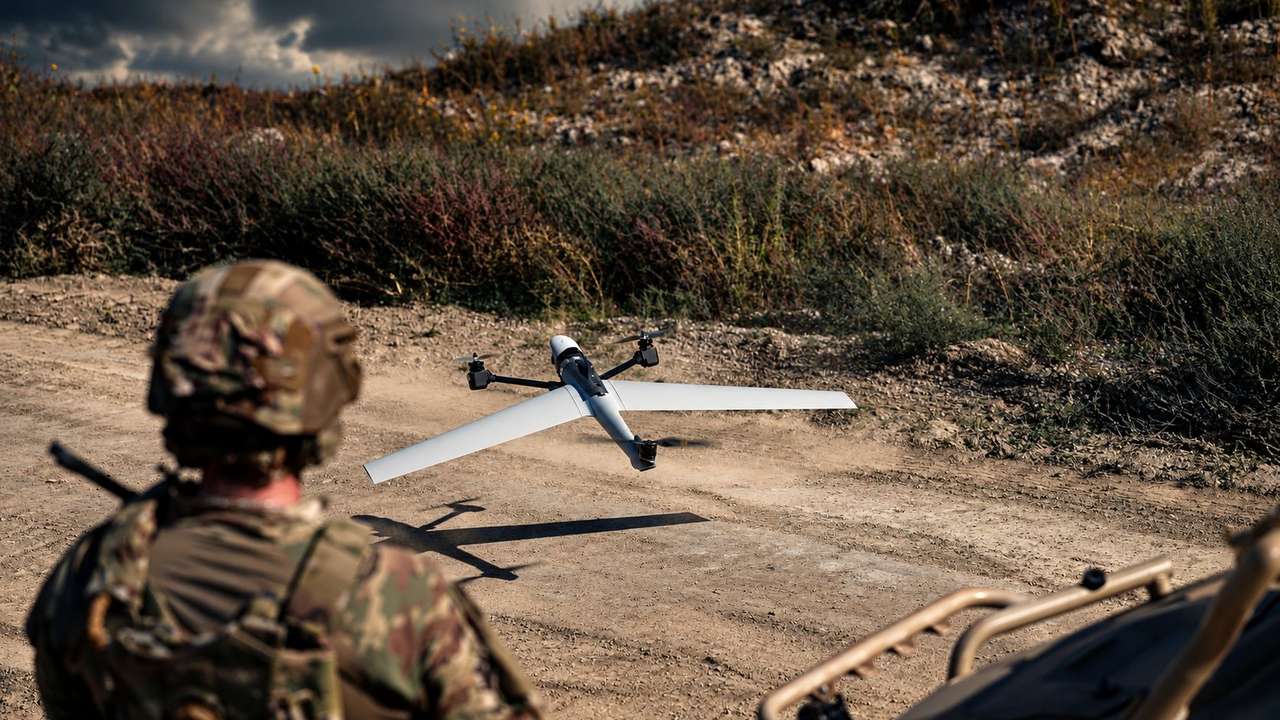
Trichon is a hybrid vertical-takeoff-and-landing (VTOL) tricopter developed by Teal Drones (marketed as Red Cat Aerial) of the United States, first introduced at LANDEURO in July 2025 and formally launched as a Red Cat Aerial product at AUSA 2026 in October 2026. It is built for extended short-range intelligence, surveillance and reconnaissance (ISR) and mapping missions, combining a tricopter lift system for launch from unprepared sites with efficient fixed-wing cruise.
Overview
Red Cat Holdings introduced Trichon publicly at LANDEURO 2025 as a design under development, pairing long-endurance VTOL flight with a tool-free payload-swapping system aimed at mapping, infrastructure inspection and intelligence-gathering missions. The company's October 2026 press release unveiling the unified "Red Cat Aerial" brand at AUSA 2026 named TRICHON as the division's newest platform, describing it as hand-launched and designed to pair long-endurance ISR with the same "proven electronics core" used across Red Cat's other aircraft; the release gave no numeric specifications and named no operators.
Trichon sits in Red Cat's "Extended Short Range Reconnaissance" (Extended SRR) category alongside the separate Black Widow quadcopter, which is built for the shorter-range SRR role, and within the wider Arachnid Family of Systems that also includes the retrievable FPV drone FANG F7. As of October 2026, Red Cat's product page lists Trichon as available for early procurement through the Red Cat Storefront, with pricing handled on request; the manufacturer states that all published specifications are preliminary and will be validated before the product formally releases.
Design and capabilities
Trichon weighs 2,500 g as a bare airframe, or 2,800 g with a 300 g payload fitted, and measures 66 cm long, 15 cm tall, with a 150 cm wingspan, according to Teal Drones' product page. A tricopter rotor arrangement lifts the aircraft vertically from any clear patch of ground with no launcher, runway or ground equipment, after which it transitions to wing-borne cruise at a nominal 17 m/s (about 61 km/h), up to a maximum of 25 m/s (90 km/h). The manufacturer quotes mission endurance of 60 to 90 minutes with a payload aboard; hover-only endurance, which it describes as the most demanding rotor-borne figure, is lower still — 17 minutes with the EO/IR payload, 19 minutes with the mapping array, and 24 minutes in the unladen trainer configuration. Power comes from a lithium-ion 5S2P battery pack rated at 180+ Wh.
The aircraft takes a maximum payload of 350 g across three interchangeable configurations: an EO/IR gimbal (Ocellus-2CP, built on a Hadron 640R+ core) giving a 64 MP visible camera with 6x digital zoom and a 640 × 512 radiometric thermal camera with 3x digital zoom; a mapping array of three simultaneously triggered 13 MP cameras producing up to 39 MP of combined image data at up to 5 fps, covering a 100 m wide swath at 1 cm per pixel; and an unladen trainer configuration. Communications run over a 900 MHz command-and-control link and a 2.4 GHz datalink, with a quoted video range of 11 to 15 km. The airframe is rated IP54 and tolerant of 17 m/s sustained wind, 6 m/s gusts and 48 °C ambient temperature in continuous fixed-wing operation, with reduced tolerance in hover.
Operational history
Trichon has not been reported in service with any named operator. Red Cat's AUSA 2026 release frames it as built on technology "already trusted by U.S. and allied operators" through Red Cat's other programmes, such as Black Widow's selection for the US Army's Short Range Reconnaissance Program of Record, but names no Trichon customer or contract. The manufacturer lists the aircraft as open for early procurement rather than general sale.
Frequently asked questions
What is the range of Trichon?
Teal Drones quotes a video datalink range of 11 to 15 km.
How long can Trichon fly?
60 to 90 minutes of mission endurance with a payload aboard, per the manufacturer; hover-only endurance is lower, from 17 to 24 minutes depending on configuration.
How does Trichon take off and land?
Vertically, using a tricopter rotor system that needs no launcher, runway or ground equipment, before transitioning to fixed-wing cruise on its 150 cm wing.
How much does Trichon weigh?
2,500 g as a bare airframe, or 2,800 g with a 300 g payload fitted, according to the manufacturer.
Who makes Trichon?
Teal Drones, a Red Cat Holdings company marketed under the "Red Cat Aerial" brand.
Is Trichon in service?
No named operator has been reported as of October 2026; the manufacturer lists it as open for early procurement, with specifications described as preliminary pending validation before release.