AWHERO
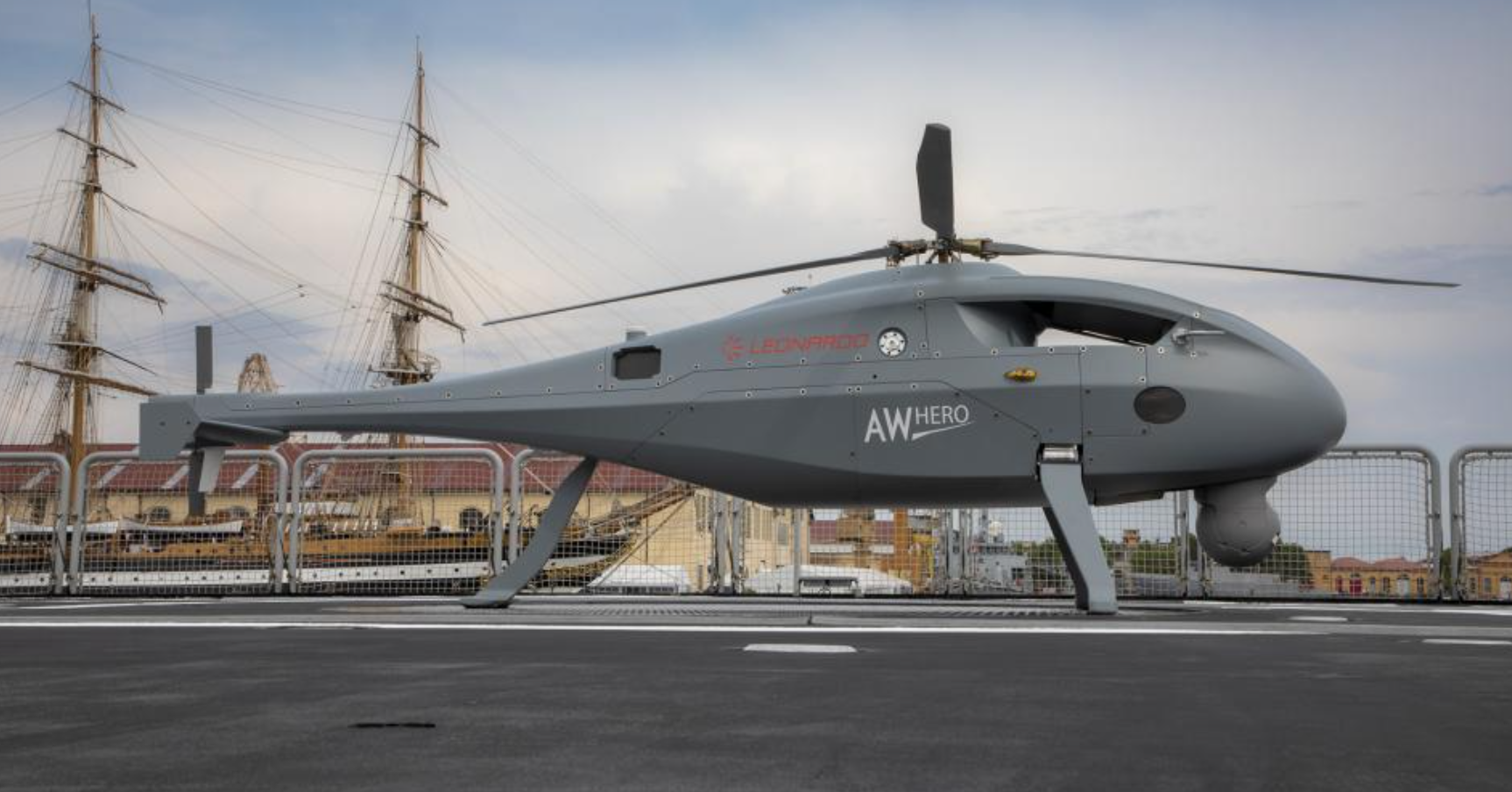
AWHERO is a 200-kilogram-class rotary-wing uncrewed aerial system developed by Leonardo of Italy, first flown in 2018. It is built for shipborne and land-based intelligence, surveillance, target acquisition and reconnaissance (ISTAR), and it is one of the few systems in its weight class designed from the outset for automated launch and recovery aboard small naval vessels.
Overview
The AWHERO programme originated in 2012 as a joint effort involving Sistemi Dinamici, an Italian rotorcraft-UAS specialist founded in 2006, before Leonardo assumed full ownership of the project in 2016. The aircraft first flew in December 2018 near Rome, and in February 2019 Leonardo opened a dedicated production and test facility in Pisa, scaling assembly capacity from roughly 20 to 70-80 units per year across twelve assembly stations.
From 2019 the platform was a centerpiece of OCEAN2020, a European Defence Fund-backed maritime-surveillance research initiative coordinating more than 40 European organizations and several uncrewed air, surface and underwater systems. In October 2021 AWHERO received basic military certification from the Italian Ministry of Defence's Directorate for Air Armaments and Airworthiness, which Leonardo describes as the first such approval granted anywhere to a 200 kg-class rotary UAS, based on STANAG 4702 airworthiness criteria.
In June 2023, at the SEAFUTURE exhibition in La Spezia, Leonardo unveiled an enhanced AWHERO configuration with airframe and payload-bay modifications, demonstrating the type aboard an Italian Navy Paolo Thaon di Revel-class offshore patrol vessel. As of the most recent manufacturer disclosures, the system continues to be marketed toward international naval tenders, including a Northrop Grumman Australia-Leonardo team offering for the Royal Australian Navy's Project SEA 129 Phase 5 requirement, without a publicly confirmed production order.
Design and capabilities
AWHERO is a conventional single-main-rotor helicopter with a four-bladed main rotor and a two-bladed tail rotor, a rotor diameter of 4.0 m and a fuselage length of 3.7 m. Maximum take-off weight is rated at 200 kg, with an empty weight of roughly 120 kg, leaving a usable weight budget for fuel and payload. The aircraft runs on a heavy-fuel powerplant burning JP-5, JP-8 or Jet A-1; the original single-engine layout was superseded in the 2023 update by a twin-engine heavy-fuel configuration intended to improve efficiency, safety margins and time between overhauls.
Payload is carried in two modular bays, a nose station rated up to 20 kg and a belly station rated up to 40 kg, allowing sensor payloads such as electro-optical/infrared turrets, maritime radar, automatic identification system (AIS) receivers, electronic support measures, sonobuoy data-relay equipment, LiDAR, signals-intelligence payloads and hyperspectral cameras to be swapped according to mission. Sensor and telemetry data are relayed to the ground or ship control station over a digital-video-broadcasting-based payload datalink with a stated range of 100 km. Endurance is rated at 6 hours.
The airframe is designed for automated shipborne operation, incorporating triple-redundant flight-control systems, a dedicated deck sensor and automatic deck-landing modes intended to allow recovery aboard small combatants in adverse sea states without a dedicated flight deck crew beyond normal operating personnel.
Operational history
AWHERO has not been publicly confirmed as procured or fielded by any national military as of the most recent manufacturer and trade-press reporting. The Italian Ministry of Defence certified the type for military airworthiness in October 2021, and Leonardo has flown demonstration missions aboard Italian Navy vessels, including the 2023 SEAFUTURE demonstration. The aircraft was also offered, in partnership with Northrop Grumman Australia, to the Royal Australian Navy's Project SEA 129 Phase 5 Block 1 uncrewed aerial system requirement, with the Leonardo-Northrop Grumman team reported as down-selected to a later evaluation phase; no contract award to that team has been publicly confirmed. AWHERO has also been demonstrated under the EU-funded OCEAN2020 maritime-surveillance initiative since 2019.
Frequently asked questions
How much does AWHERO weigh?
AWHERO has a maximum take-off weight of 200 kg, placing it in Leonardo's "200 kg class" of rotary uncrewed aerial systems.
How long can AWHERO stay airborne?
The manufacturer rates AWHERO's endurance at 6 hours on a single mission.
What payload can AWHERO carry?
AWHERO has two modular payload bays, a nose station rated up to 20 kg and a belly station rated up to 40 kg, for sensors such as EO/IR turrets, maritime radar and signals-intelligence equipment.
When did AWHERO first fly?
The prototype's first flight took place in December 2018, near Rome, after a development programme that began in 2012.
Is AWHERO in military service?
AWHERO received Italian military airworthiness certification in October 2021, but no country has been publicly confirmed as an operational user as of the most recent reporting.
What powers AWHERO?
AWHERO uses a heavy-fuel engine burning JP-5, JP-8 or Jet A-1; a twin-engine version of this powerplant was introduced in the 2023 upgrade.
SourcesChecked
- AWHERO | Leonardo Aeronautics
- AWHERO Unmanned Helicopter
- Leonardo AWHERO Rotary Unmanned Air System (RUAS)
- Leonardo AWHero achieves first military certification
- Leonardo Unveils Upgraded AWHero Rotary Uncrewed Aerial Vehicle
- Leonardo AWHERO
- Euronaval 2018: Leonardo's AWHERO RUAS at the core of upcoming OCEAN2020 demonstrations