AR.Drone
Parrot · France · also known as Parrot AR.Drone, AR.Drone 2.0, Parrot AR.Drone 2.0, AR Drone · Updated
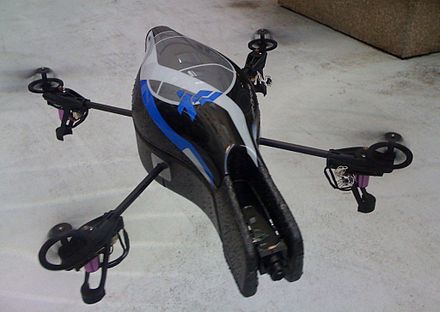
AR.Drone is a consumer quadcopter developed by Parrot of France and unveiled at CES in Las Vegas on 5 January 2010. It was one of the first ready-to-fly camera drones controlled from a smartphone over Wi-Fi, and its successor, the AR.Drone 2.0 of January 2012, added a 720p camera. Both models are no longer produced; the specifications on this page refer to the AR.Drone family as documented by Wikipedia, with figures for the original airframe unless stated otherwise.
Overview
Parrot presented the AR.Drone at CES 2010 as a flying video game: the aircraft streamed live video to an iPhone or iPod touch, from whose screen it was steered, and augmented-reality games overlaid targets on the video feed. According to DRONELIFE the aircraft reached shops later in 2010 at 299 US dollars, and the writer credits it with showing that a mainstream market existed beyond the hobbyists who then built multirotors from kits.
The AR.Drone 2.0 was announced in January 2012 with a faster ARM Cortex-A8 processor, a 720p forward camera and improved stabilisation sensors, while keeping the same layout and price class. Wikipedia records that around half a million AR.Drone and AR.Drone 2.0 units had been sold by early 2013. The design was later followed by Parrot's Bebop (2014), Disco (2016) and ANAFI (2018) lines, and the company has since moved to professional micro-UAVs such as the ANAFI USA and ANAFI Ai. Parrot's current product pages no longer list the AR.Drone, so this entry treats it as retired.
Design and capabilities
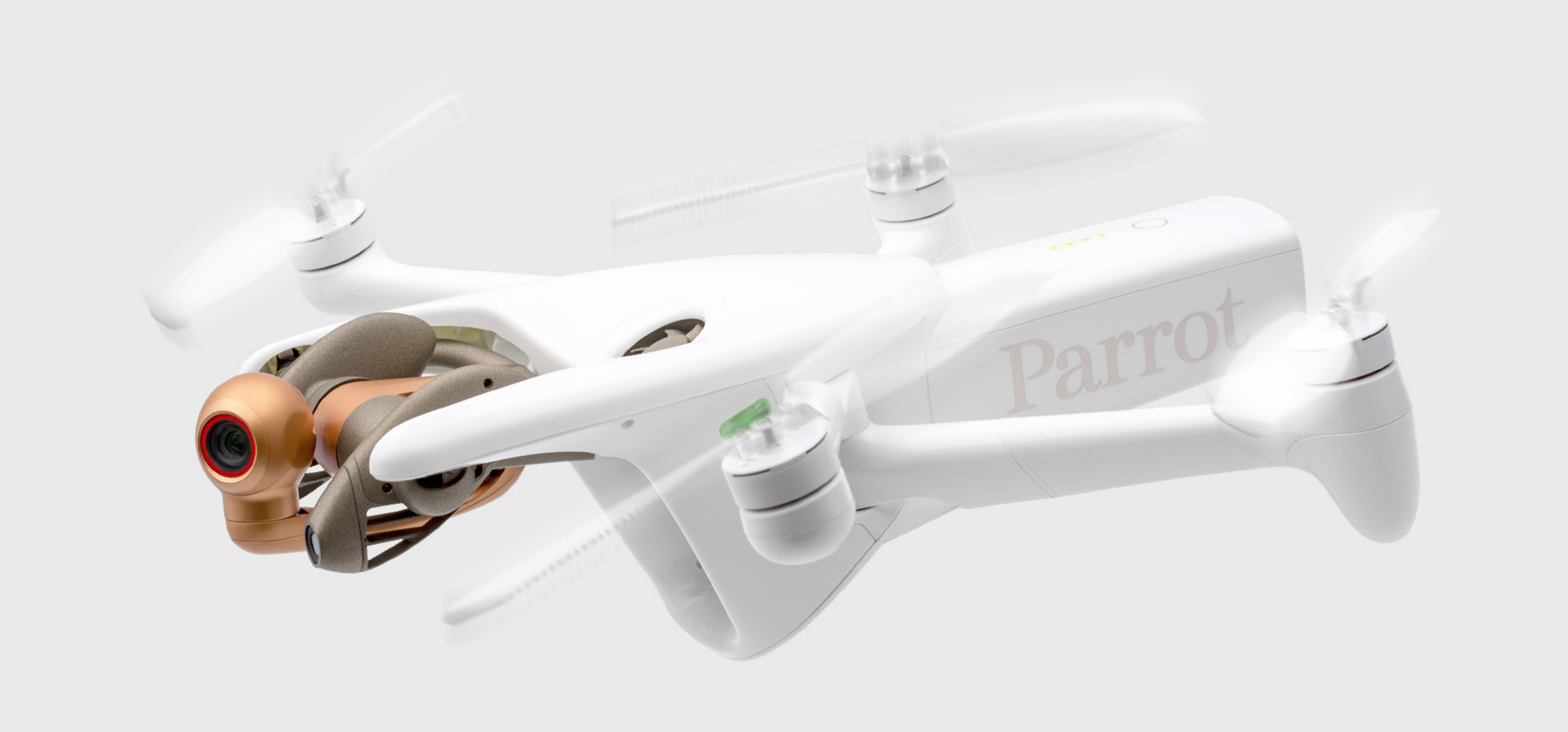
The AR.Drone is a quadcopter whose airframe is built from PA66 plastic and carbon-fibre tubes, with four brushless motors. Wikipedia gives its length as 0.45 m and its width as 0.29 m without the hull, and 0.525 m by 0.515 m with the indoor hull fitted; the weight is 0.36 kg without the hull and 0.40 kg with the indoor hull, which is the take-off weight used in the specs block. Two interchangeable hulls were supplied: an outdoor hull that leaves the propellers exposed, and an indoor hull of expanded polypropylene foam with bumpers that protect the propellers and nearby objects.
Power comes from an 11.1 V, 1,000 mAh lithium-polymer battery, giving an endurance of about 15 minutes on the original model; Wikipedia quotes 15 to 25 minutes for the AR.Drone 2.0 depending on the battery fitted. Maximum speed is 18 km/h (5 m/s). The original aircraft used a 468 MHz ARM9 processor running Linux, a 480p forward-facing camera and a 144p downward camera that, together with a 40 kHz ultrasonic rangefinder, provided position hold and automatic take-off and landing. The AR.Drone 2.0 replaced the front camera with a 720p unit and added an air-pressure sensor and a three-axis magnetometer.
Control is entirely by Wi-Fi: the aircraft creates its own network to which the phone or tablet connects, and Parrot's free iOS and Android application shows the video feed and flight controls. Parrot quoted a ceiling of 50 m, but Wikipedia notes that in testing the Wi-Fi link tended to drop before that altitude was reached; the practical horizontal range is likewise limited by Wi-Fi, so no range figure is given in the specs block. Parrot released an open API for game and application development, and Wikipedia describes the aircraft as an increasingly popular tool in research and education.
Use cases
The AR.Drone was sold as a recreational product for indoor and outdoor flying, augmented-reality games and casual aerial video. Its open API, low price and built-in sensors also made it a common platform in research and education.
Variants
- AR.Drone (2010) – original model with 480p forward camera, 144p downward camera and ARM9 processor.
- AR.Drone 2.0 (2012) – 720p forward camera, ARM Cortex-A8 processor, air-pressure sensor and three-axis magnetometer; also sold as the AR.Drone 2.0 Elite Edition and AR.Drone 2.0 Power Edition.
Frequently asked questions
What is the range of the AR.Drone?
The aircraft is controlled over a Wi-Fi link from a phone or tablet, so its range is limited to Wi-Fi distance; Parrot quoted a 50 m ceiling and Wikipedia notes the link often dropped before that height.
How long can the AR.Drone fly?
About 15 minutes on the original 1,000 mAh battery; Wikipedia gives 15 to 25 minutes for the AR.Drone 2.0 depending on the battery.
How much does the AR.Drone weigh?
0.36 kg without a hull and 0.40 kg with the indoor protective hull.
When was the AR.Drone released?
It was unveiled at CES on 5 January 2010 and reached shops later that year; the AR.Drone 2.0 was announced in January 2012.
Is the AR.Drone still made?
No. Parrot no longer lists it, and the company now concentrates on professional micro-UAVs in the ANAFI family.