Bayraktar KALKAN
Baykar Tech · Türkiye · also known as Bayraktar DİHA, Bayraktar DIHA, KALKAN DİHA, Bayraktar VTOL · Updated
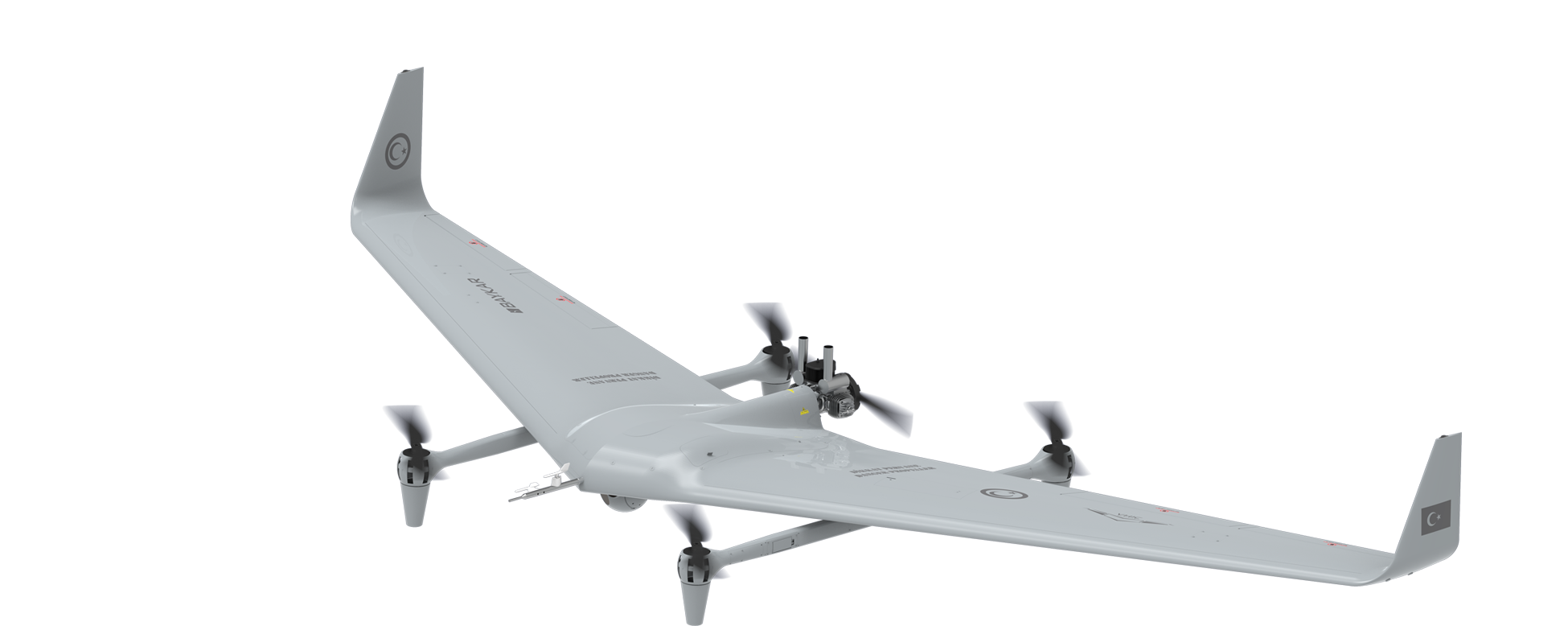
Bayraktar KALKAN is a hybrid vertical-take-off-and-landing (VTOL) unmanned aircraft developed by Baykar of Turkey for intelligence, surveillance and reconnaissance missions. Baykar's own product page still uses the URL "bayraktar-diha" — DİHA being the Turkish abbreviation for a vertical-takeoff-and-landing UAV — and the aircraft is referred to interchangeably as Bayraktar DİHA, KALKAN DİHA and Bayraktar VTOL across Baykar's and Turkish media's materials.
Overview
Baykar launched the programme in 2019, originally intending the aircraft to operate from the Turkish amphibious assault ship TCG Anadolu. It first flew in August 2019 and had completed around 30 recorded flight tests by April 2024. In early 2025, Baykar demonstrated a "mothership" capability by launching a small first-person-view (FPV) drone from the aircraft in mid-air. On 20 August 2026, the type was integrated aboard the frigate TCG Oruçreis for a Turkish naval exercise at Gölcük Naval Shipyard, extending Baykar's VTOL UAV family to another class of surface vessel.
Design and capabilities
The aircraft has a 5-metre wingspan, is 1.9 metres long and 0.7 metres high, with a maximum take-off weight of 78 kg and a payload capacity of 3 kg. Four electric motors handle vertical take-off and landing, after which the aircraft transitions to a single internal-combustion engine for forward cruise flight — removing the need for a runway while still giving fixed-wing-like range and endurance. Baykar states a cruise speed of 48 knots and a maximum speed of 55 knots (about 89–102 km/h), a communications range of more than 70 km, a service ceiling of 10,000 ft (3,048 m), and an endurance of 6 hours. The aircraft flies fully autonomous take-off, cruise and landing profiles, with semi-autonomous modes for route tracking, target tracking, loitering and return-to-home, backed by a triple-redundant flight-control system; payloads include interchangeable electro-optical or infrared cameras, a tracking/multiple-target-identification module and a laser rangefinder.
Operational history
Turkish Armed Forces are the only confirmed operator. As of Baykar's most recent public test milestones, the aircraft was in a production/fielding phase, having progressed from shipboard trials aboard TCG Anadolu to integration with the frigate TCG Oruçreis in August 2026. No export order has been publicly disclosed.
It is part of Baykar's wider VTOL and tactical UAV family alongside the much larger Bayraktar Akıncı.
Frequently asked questions
What is the Bayraktar KALKAN (DİHA)?
A hybrid VTOL unmanned aircraft from Baykar of Turkey, used for ISR missions and designed to operate from ships without a runway.
How is it different from DİHA?
DİHA is the Turkish category term for a VTOL UAV; Baykar and Turkish media use KALKAN, KALKAN DİHA and Bayraktar VTOL interchangeably for the same aircraft, which still sits at the "bayraktar-diha" URL on Baykar's own site.
How long can it fly?
Baykar states an endurance of 6 hours.
How much can it carry?
A payload of up to 3 kg, which can include electro-optical or infrared cameras and a laser rangefinder.
How does it take off and land?
Vertically, using four electric motors, before transitioning to a single combustion engine for cruise flight — no runway required.
Who operates it?
The Turkish Armed Forces, including shipboard trials aboard the amphibious ship TCG Anadolu and the frigate TCG Oruçreis.