Unmanned Little Bird H-6U
Boeing · United States · also known as BIRD H-6U, H-6U, Unmanned Little Bird, ULB · Updated
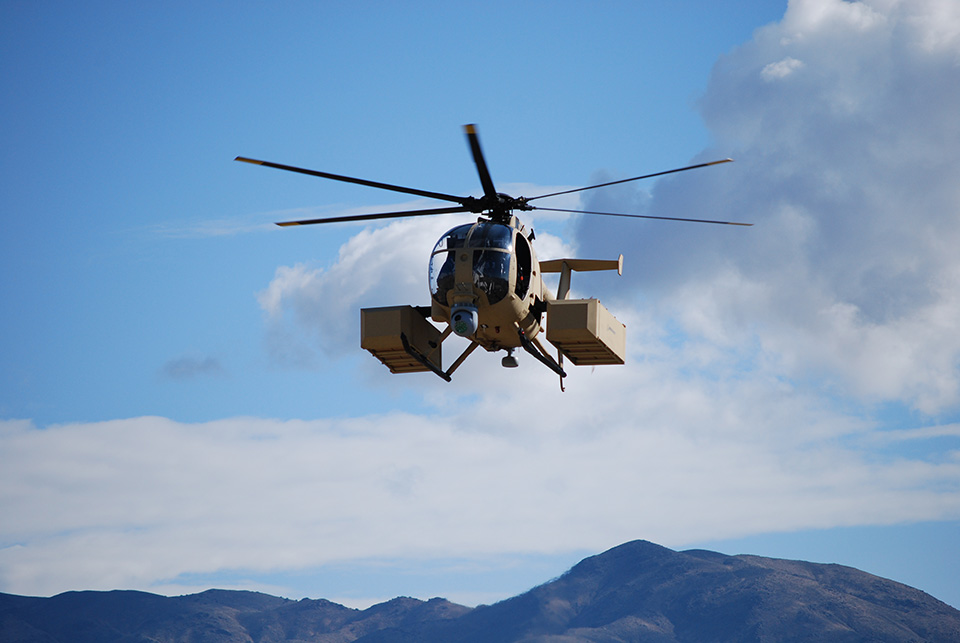
Unmanned Little Bird H-6U is an optionally piloted helicopter developed by Boeing from the MD 500 series light helicopter family, first flown in autonomous mode in 2004 and demonstrated repeatedly since in land- and ship-based trials. It combines a commercial-off-the-shelf take-off-and-landing system with an automated flight control system fitted to the MD 530F airframe, letting the same aircraft fly fully crewed, with safety pilots aboard, or fully uncrewed.
Overview
Boeing built the demonstrator, often referred to as the ULB (Unmanned Little Bird), from a civilian MD 530F airframe. It first flew on 8 September 2004 and made its first autonomous flight the following month, with a safety pilot aboard; it flew its first fully uncrewed, pre-programmed mission from Yuma Proving Ground on 30 June 2006. In 2006 the US Army's AMUST-D programme used the aircraft to remotely fire AGM-114 Hellfire missiles cued from an AH-64 Apache. Boeing has pitched the H-6U as a flexible platform for intelligence, surveillance and reconnaissance, precision cargo resupply, weapons delivery and manned-unmanned teaming, as well as a technology demonstrator for prototyping new autonomy systems on a proven rotorcraft.
Design and capabilities
Boeing's H-6U specification lists a main rotor diameter of 8.38 m, a service ceiling of 20,000 ft (6,100 m) and an endurance of about 6 hours; its stated maximum speed converts to roughly 268.5 km/h. The aircraft carries an automated flight control system layered on the standard MD 500-series helicopter, with a Ku-band tactical common data link used in some configurations. Because the airframe can be flown with a pilot, with safety pilots as observers, or with nobody aboard, Boeing has marketed it as a tool for training crews and flight-testing new unmanned systems technology before committing to a purpose-built design.
Operational history
In summer 2011 an H-6U made autonomous landings on a moving truck bed in trials for the French firms Thales and DCNS, ahead of planned 2012 frigate sea trials. In July 2012 Boeing flew an H-6U from a ship off the coast of Florida, completing 14 autonomous takeoffs and landings and accumulating 20 flight hours with full availability; two safety pilots rode aboard but did not need to take control. That December, Boeing flew an autonomous land-based demonstration for the Republic of Korea Army to show how the technology could be integrated onto that force's existing MD 500 helicopters. In September 2013, Boeing and Aurora Flight Sciences offered the H-6U for a US Marine Corps unmanned cargo-resupply competition, with evaluation due to begin at Quantico in February 2014. No operator has placed a known production order for the H-6U itself; the demonstrations above have been with the US Army, the French Navy's shipbuilder partners, and the Republic of Korea Army.
Frequently asked questions
Is the H-6U crewed or uncrewed?
Both: the same airframe can be flown fully crewed, with safety pilots aboard as observers, or with nobody aboard, which Boeing has used to test unmanned flight-control technology on a proven helicopter.
When did the H-6U first fly?
The demonstrator first flew in September 2004 and made its first fully autonomous, uncrewed flight in June 2006.
What is the H-6U's endurance and ceiling?
Boeing states an endurance of about 6 hours and a service ceiling of roughly 6,100 m (20,000 ft).
Has the H-6U seen combat or entered service?
No confirmed operational deployment or production order has been reported. It has been demonstrated in land- and ship-based trials for the US Army, French naval partners and the Republic of Korea Army.