X-37B Orbital Test Vehicle
Boeing · United States · Space · also known as X-37, OTV, Orbital Test Vehicle · Updated
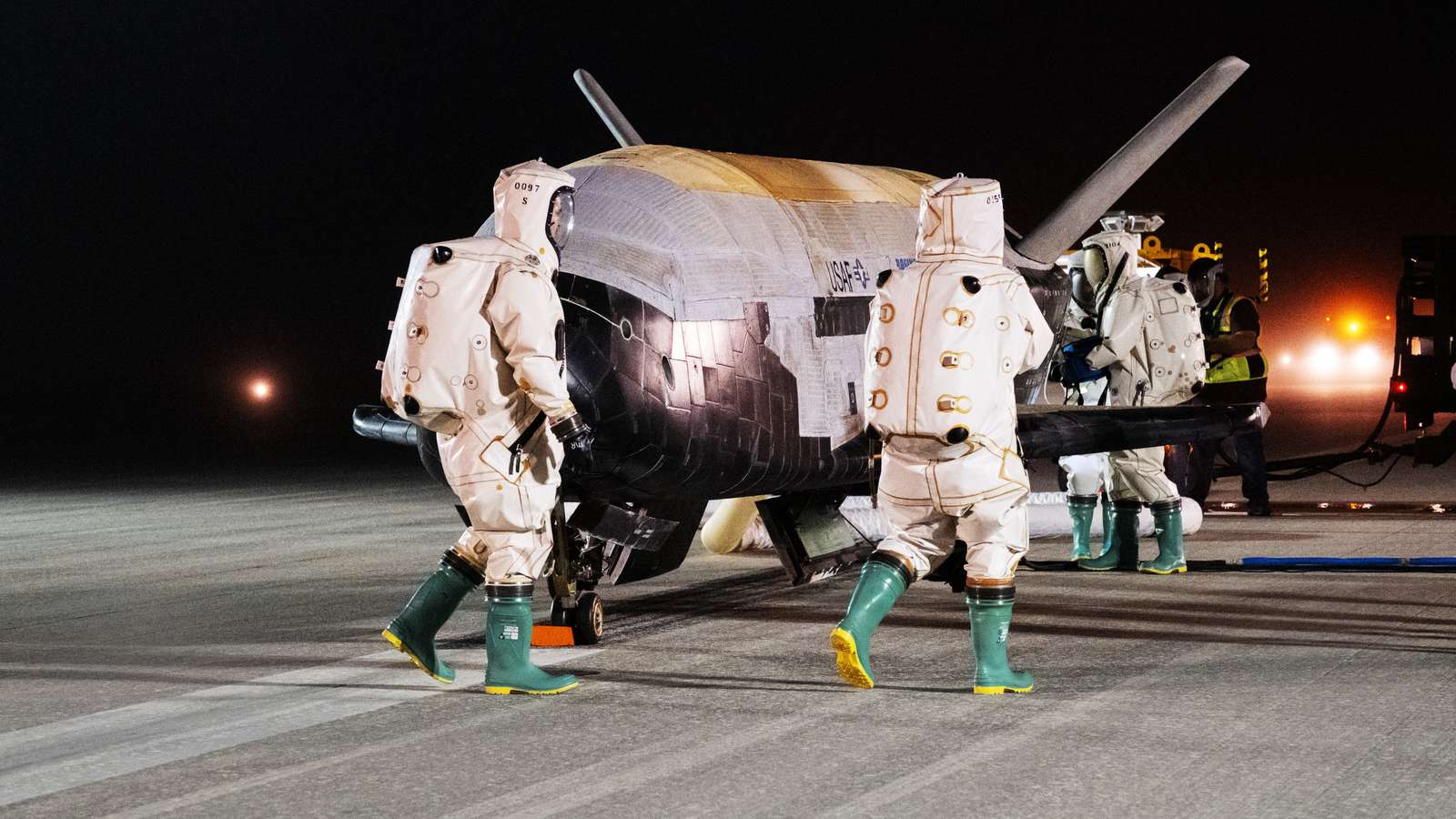
The X-37B Orbital Test Vehicle is an uncrewed, reusable spaceplane built by Boeing and flown by the United States Space Force with the Air Force Rapid Capabilities Office. It launches vertically on a conventional rocket, spends months or years in orbit carrying experiments, then re-enters and lands horizontally on a runway. The first orbital mission launched on 22 April 2010, and an eighth mission launched in August 2025.
Design and capabilities
The vehicle is 8.92 metres long with a wingspan of 4.55 metres and a height of 2.90 metres, and it launches at about 4,990 kg. Its shape follows the layout of a scaled-down Space Shuttle orbiter, with a double-delta wing, twin canted vertical stabilisers and a thermal protection system of tiles and toughened blankets. Behind the crew-less forward section sits a payload bay roughly 2.1 by 1.2 metres, which opens on orbit and can carry experiments, deployable satellites and exposure trays.
On-orbit manoeuvring uses a hypergolic propulsion system burning nitrogen tetroxide and hydrazine. Electrical power comes from a deployable gallium arsenide solar array charging lithium-ion batteries, which is what allows missions to run far longer than the Shuttle's two-week limit. Because the vehicle returns to a runway intact, hardware flown on one mission can be recovered, inspected and improved rather than being discarded on re-entry, which is the main reason the programme is described as a testing platform rather than an operational satellite.
Programme status
An atmospheric drop test took place on 7 April 2006, and orbital flights began four years later. The missions have run as follows: OTV-1 launched 22 April 2010 and landed 3 December 2010 after 224 days; OTV-2 flew from 5 March 2011 to 16 June 2012, 468 days; OTV-3 from 11 December 2012 to 17 October 2014, 674 days; OTV-4 from 20 May 2015 to 7 May 2017, 717 days; and OTV-5 from 7 September 2017 to 27 October 2019, 779 days.
OTV-6 set the programme's duration record, launching on 17 May 2020 and landing on 12 November 2022 after 908 days in orbit. OTV-7 launched on 29 December 2023 and landed on 7 March 2025 after 434 days, during which the vehicle carried out an aerobraking manoeuvre to change orbit while conserving propellant. OTV-8 launched on a SpaceX Falcon 9 from Kennedy Space Center on 21 August 2025, carrying laser communications, quantum inertial sensing and a NASA materials exposure experiment. Boeing said in April 2026 that the mission had passed 230 days on orbit.
FAQ
Is it flying today? Yes. Seven missions have been completed and the eighth was still in orbit when Boeing published an update in April 2026.
How many people does it carry? None. The X-37B is uncrewed and operates autonomously, including its runway landing.