Phantom Eye
Boeing · United States · Updated
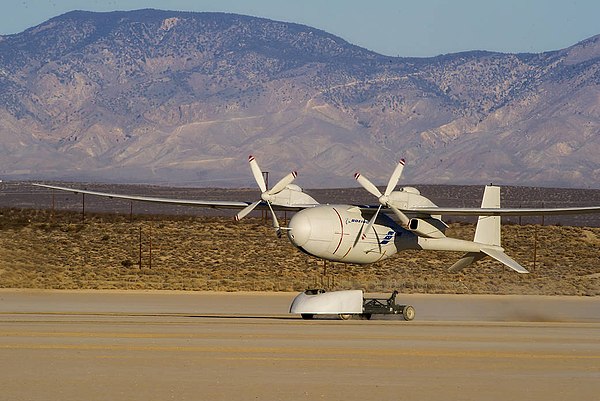
Phantom Eye was an experimental, hydrogen-powered high-altitude, long-endurance (HALE) demonstrator built by Boeing, first flown on 1 June 2012. It was designed to explore whether an uncrewed aircraft could stay aloft for four to ten days at a time as a persistent, low-cost alternative to a surveillance satellite.
Overview
Phantom Eye grew out of Boeing's earlier piston-engined Condor demonstrator programme. Its liquid-hydrogen propulsion system completed an 80-hour altitude-chamber endurance test on 1 March 2010, and the airframe was publicly unveiled at Boeing's St. Louis facility on 12 July 2010. The concept was to combine a very lightweight, high-aspect-ratio airframe with clean-burning hydrogen engines to achieve endurance far beyond that of conventional gasoline- or turboprop-powered HALE aircraft.
Design and capabilities
The demonstrator had a 46 m (150 ft) wingspan and was powered by two hydrogen-fuelled, modified Ford 2.3-litre piston engines producing about 150 hp each at sea level. It could carry roughly 204 kg (450 lb) of payload, cruise at about 150 knots (278 km/h), and was designed to reach a service ceiling of about 65,000 ft (19,812 m). Boeing's goal for the demonstrator was up to four days of endurance, with a planned full-size production aircraft targeted at seven to ten days.
Operational history
On its first flight on 1 June 2012 at Edwards Air Force Base, California, the aircraft reached about 4,000 ft and 62 knots for a 28-minute flight before sustaining landing-gear damage on landing. It went on to complete nine test flights through 2014, validating the airframe and hydrogen propulsion concept but never attempting a multi-day endurance flight. In August 2016 Boeing retired the demonstrator, and it was disassembled for static display at the Air Force Flight Test Museum at Edwards Air Force Base, where it remains today.
Frequently asked questions
How long could the Phantom Eye stay airborne?
Boeing designed the demonstrator for up to four days of endurance, with a planned production version targeted at seven to ten days, though no multi-day flight was ever attempted.
What powered the Phantom Eye?
Two modified Ford 2.3-litre piston engines burning liquid hydrogen, chosen for high efficiency and clean exhaust (mostly water vapour) at high altitude.
Is the Phantom Eye still flying?
No. Boeing retired the demonstrator in 2016 after nine test flights; it is now a static display at the Air Force Flight Test Museum at Edwards Air Force Base.
How high did the Phantom Eye fly?
It was designed for a service ceiling of about 65,000 ft (19,812 m), though its test flights stayed at low altitude to validate the airframe.
Who built the Phantom Eye?
Boeing, developing it as a company-funded technology demonstrator rather than a program of record for the US military.