BXAP15
BHE Bonn Hungary · Hungary · Updated
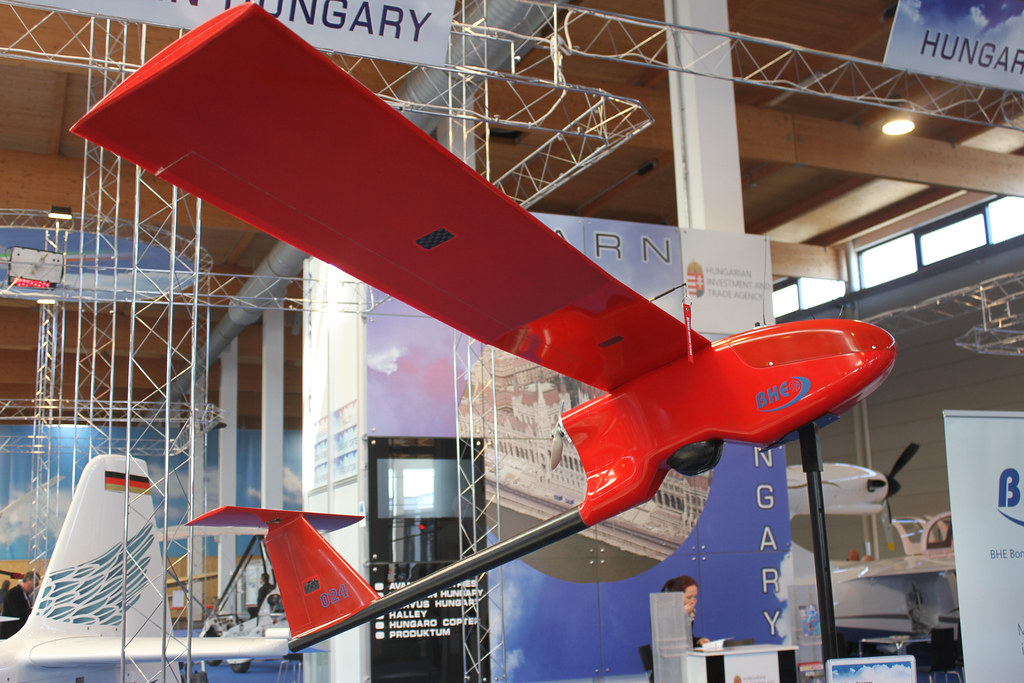
BXAP15 is a small fixed-wing reconnaissance UAV developed by BHE Bonn Hungary Electronics, designed to fly a preprogrammed route while sending real-time video and position data back to a ground control station. BHE's product listing pitched it for infrastructure patrol, disaster monitoring, precision agriculture, wildlife monitoring, border control and geodesy; the manufacturer's own site no longer lists a UAV product line, so the type is treated here as discontinued.
Overview
BHE Bonn Hungary Electronics, a Budapest-based RF and microwave engineering firm, built BXAP15 as part of a small UAV family that also included the lighter BXAP13. The airframe uses composite construction and is pitched as easy to transport, assemble and operate, with catapult launch and recovery that needs no special equipment. BHE's product page listed encrypted radio communication, a real-time video downlink over C-band, and onboard flight-data logging among its standard features.
A documented real-world use of BXAP15 was a planetary-boundary-layer meteorological sounding project run by researchers from Eötvös Loránd University's meteorology department, the Hungarian National University of Public Service's military aviation department, and the Budapest University of Technology and Economics. Their aircraft, designed and operated for them by BHE, first flew on 19 October 2012 at a military test range near Várpalota, Hungary, climbing in a roughly 2,000 m square pattern at about 2 m/s to a peak altitude of 3,500 m while carrying a Vaisala HMP45 temperature and humidity sensor on its nose.
Design and capabilities
BHE's specification sheet gives BXAP15 a 3.7 m wingspan, a length of 1.7 m, a maximum take-off weight of 17 kg and a payload capacity of 3 kg. It is powered by an electric brushless motor with 1200 W peak power, giving a cruise speed of 60-100 km/h (indicated airspeed), a maximum altitude of above 3,000 m above ground level, an endurance of about 90 minutes on a full battery charge, and a range of 10-20 km depending on terrain. BHE's researchers noted that the electric motor's lower heat output and vibration, compared with a piston engine, reduced interference with onboard sensors and accelerometers.
The aircraft can take off by hand launch or with a winch from the ground; shortly after take-off it flies a preprogrammed GPS route under autopilot, with the option to switch to manual control at any time, and landing is normally flown manually. Command and telemetry use a two-way microwave link between a GPS-equipped, aircraft-tracking ground transmitter and an onboard unit.
Use cases
BHE marketed BXAP15 for companies and government bodies needing to monitor remote sites or linear infrastructure such as power lines or pipelines, for natural-disaster monitoring, precision agriculture, wildlife monitoring, border control and geodesy. In practice, the only publicly documented flights are the university meteorological research campaign described above. BHE Bonn Hungary's current product catalogue covers RF and microwave equipment for critical communications, space and defence, including drone-detection modules, but no longer includes a UAV airframe, indicating the BXAP line has been discontinued.
Frequently asked questions
What was the BXAP15 used for?
BHE marketed it for infrastructure patrol, disaster monitoring, agriculture, wildlife monitoring, border control and geodesy; the only publicly documented use is a university atmospheric research campaign.
What are the BXAP15's key specifications?
BHE's spec sheet lists a 3.7 m wingspan, 1.7 m length, 17 kg maximum take-off weight and a 3 kg payload capacity.
How long could the BXAP15 fly?
BHE stated an endurance of about 90 minutes on a full battery charge, with a range of 10-20 km depending on terrain.
Is the BXAP15 still in production?
BHE Bonn Hungary's current product catalogue no longer lists a UAV airframe, so the type is treated here as retired.
Who made the BXAP15?
BHE Bonn Hungary Electronics, a Hungarian RF and microwave engineering company based in Budapest.