Dragonfly
NASA · United States · Space · also known as Titan rotorcraft lander · Updated
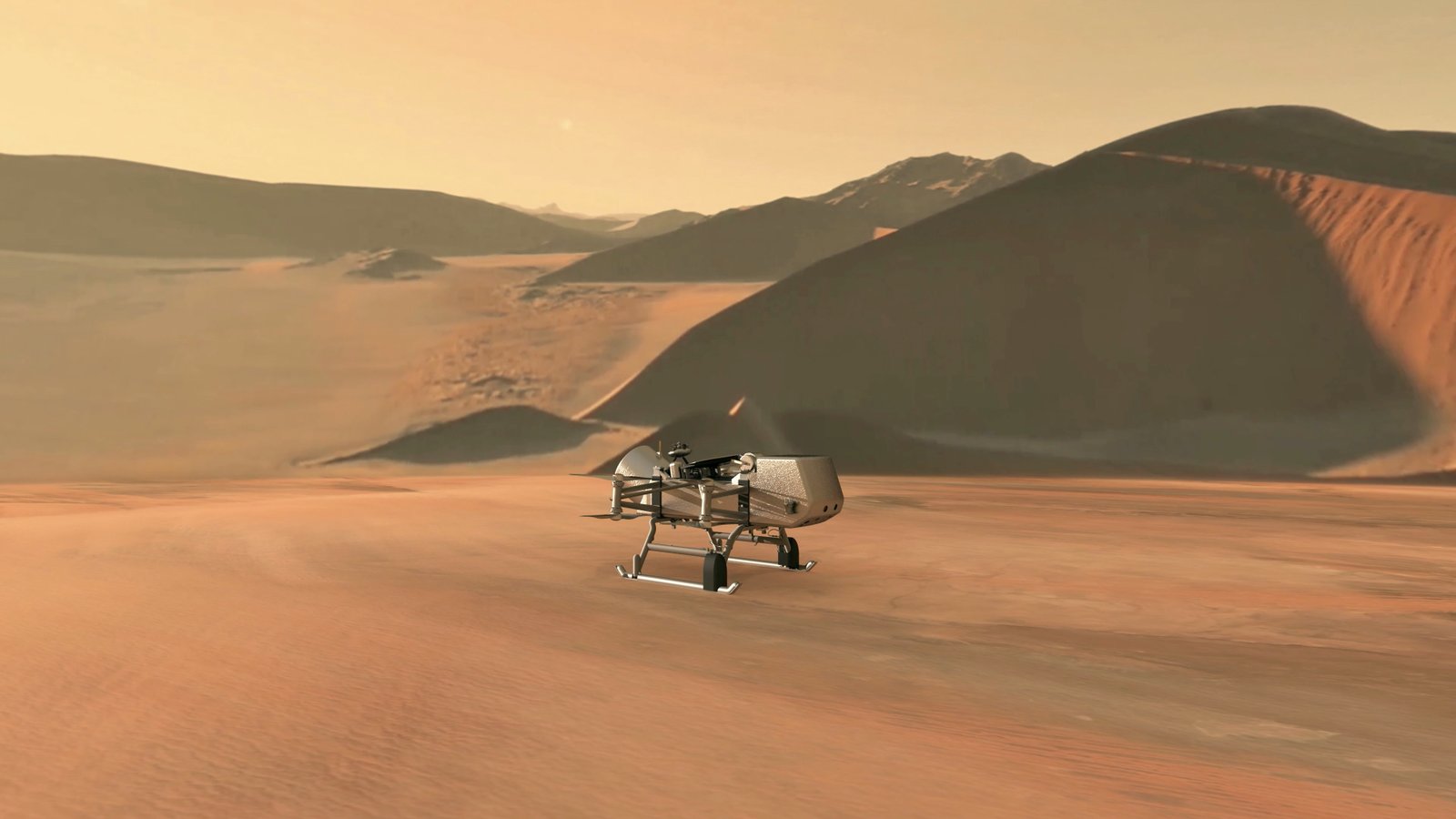
Dragonfly is an uncrewed rotorcraft lander that NASA is building to fly through the atmosphere of Titan, the largest moon of Saturn. The spacecraft is designed and assembled by the Johns Hopkins University Applied Physics Laboratory in Laurel, Maryland, under NASA direction. As of September 2026 it is in development and integration, with launch stated by NASA as no earlier than July 2028 and arrival at Titan in late 2034.
Design and capabilities
Dragonfly is arranged as an octocopter: eight sets of coaxial blades, each set 1.35 metres across, mounted on booms around a car-sized fuselage. NASA gives the vehicle as 3.85 metres long, 3.85 metres wide and 1.75 metres tall, with a mass of 875 kg. It lands on skids rather than wheels, and between flights it sits on the surface taking samples and recharging.
Power comes from a Multi-Mission Radioisotope Thermoelectric Generator, the same class of nuclear power source used on NASA's larger Mars rovers. The generator produces a steady but modest electrical output, which is stored in a battery and then drawn down rapidly during each flight. Titan suits this kind of vehicle: its atmosphere is about four times denser than Earth's at sea level, while surface gravity is roughly one seventh of Earth's, so rotors generate lift far more easily than they would on Mars. NASA says the rotorcraft can cover tens of kilometres in under an hour of flight.
The science payload is aimed at Titan's surface chemistry. Instruments include a mass spectrometer fed by a drill and sample transfer system, a gamma-ray and neutron spectrometer, a meteorology and seismology package, and a camera suite for navigation and geology. Titan's thick haze and its distance from Earth mean the vehicle must fly autonomously, planning and executing each hop without real-time control.
Programme status
NASA confirmed the mission on 16 April 2024 and it is now in build and test at the Applied Physics Laboratory. Full-scale entry, descent and landing parachute tests were completed in Arizona in February 2026. In April 2026 the team began assembling the fuselage and completed a fit check of the upper deck, and in July 2026 NASA said the fuselage had been delivered on 29 June 2026, with integration of mechanical, thermal and electrical systems starting on 1 July 2026. Structural vibration testing ran from May into early June 2026, alongside sealing tests for Titan's dense atmosphere and integration of the high-gain antenna.
The planned surface mission lasts about 3.3 years, with roughly one flight per Titan day, a period of about 16 Earth days. NASA expects the rotorcraft to visit 20 to 30 sites and to cover around 115 km from its landing point, working across dune fields and the Selk impact crater.
FAQ
Is it flying today? No. The rotorcraft is being assembled and tested on Earth; NASA states a launch window opening no earlier than July 2028 and arrival at Titan in late 2034.
How many people does it carry? None. Dragonfly is uncrewed and flies autonomously.
SourcesChecked
- Flying on Saturn's Moon - Dragonfly Spacecraft and Instruments - NASA Science
- Dragonfly - NASA Science
- NASA's Dragonfly Clears Key Tests as Titan Rotorcraft Takes Shape - NASA Science
- NASA's Dragonfly Rotorcraft Gets Decked Out, Tested - NASA Science
- NASA's Dragonfly Rotorcraft Mission to Saturn's Moon Titan Confirmed - NASA Science