X-43A
NASA · United States · Space · also known as Hyper-X, NASA X-43, X-43 · Updated
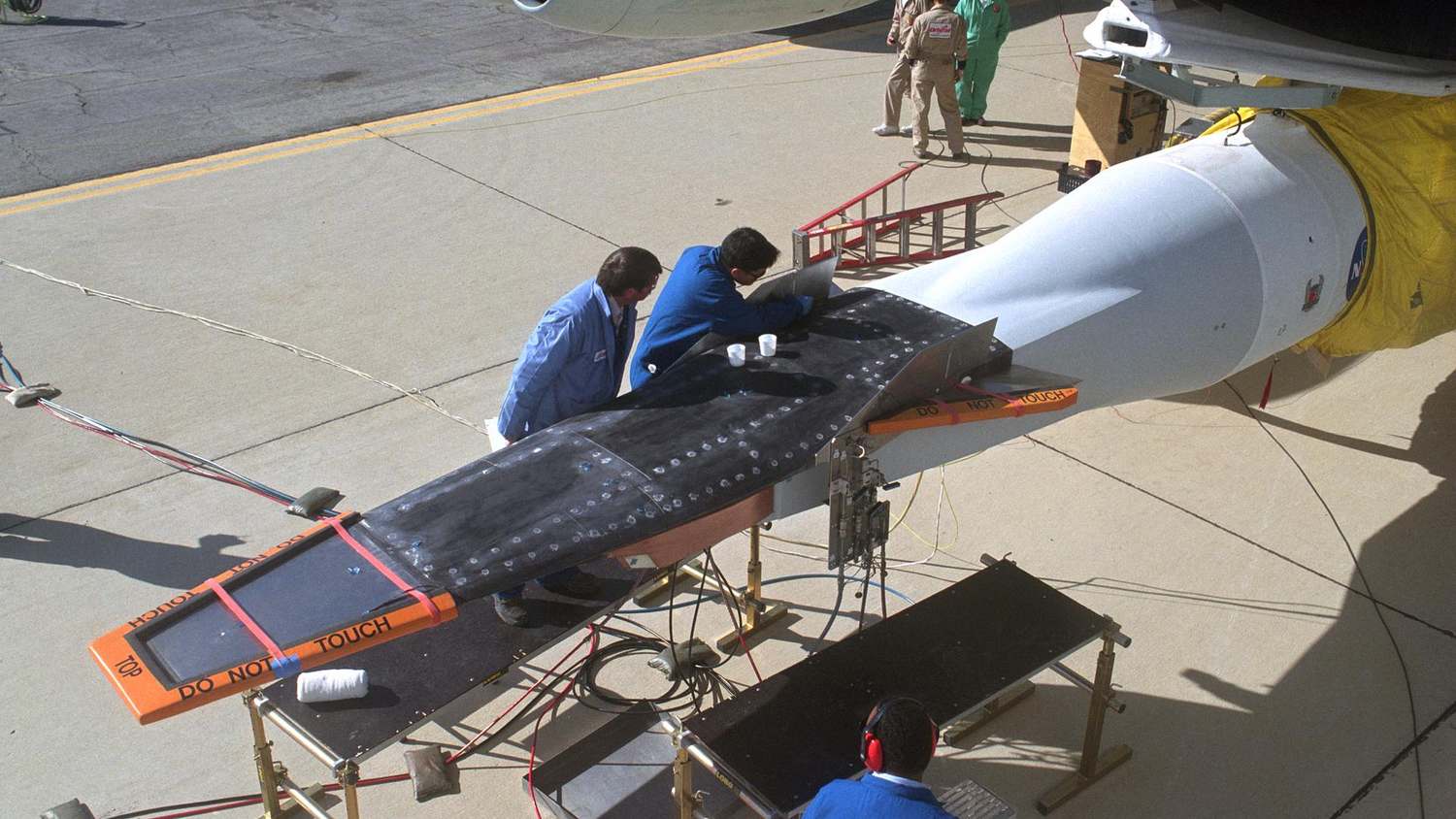
The X-43A is an uncrewed hypersonic research aircraft built for NASA under the Hyper-X programme to demonstrate a scramjet, or supersonic-combustion ramjet, in free flight. Three vehicles were built, each intended for a single non-recoverable flight. All three were flown between 2001 and 2004, and the programme is closed.
Design and capabilities
Each X-43A is about 3.7 metres long and 1.5 metres across, weighing roughly 1,400 kg. The shape is a lifting body: a flattened wedge whose forebody compresses incoming air for the engine and whose afterbody forms part of the exhaust nozzle, with small wings and twin canted tails for control. There is no separate inlet duct of the kind a conventional jet uses, because the airframe and the engine are a single aerodynamic object.
The engine burns gaseous hydrogen in air that is still moving through the combustor at supersonic speed. That removes the need to carry an oxidiser, but it only works once the vehicle is already travelling very fast, so each flight needed a two-stage boost. A B-52 carried the stack to launch altitude, then a modified Pegasus rocket first stage built by Orbital Sciences accelerated the X-43A to test condition before separation. The scramjet itself ran for roughly ten seconds. The vehicles and engines came from ATK GASL, with Boeing Phantom Works responsible for thermal protection and vehicle systems. Langley Research Center led the programme and Dryden Flight Research Center ran the flights.
Programme status
Hyper-X began in 1996. The first flight attempt was made on 2 June 2001. About 13 seconds after release from the B-52 the Pegasus booster lost control during the transonic phase, traced to a starboard elevon failure, and the stack was destroyed as a safety precaution before the X-43A ever separated.
The second vehicle flew on 27 March 2004. It separated at roughly 29,000 metres, about 95,000 feet, ran its scramjet for some eleven seconds and reached Mach 6.8, close to 7,500 km/h, before gliding for several minutes and falling into the Pacific Ocean as planned.
The third and final flight took place on 16 November 2004. The vehicle reached Mach 9.6, roughly 10,900 km/h, at about 33,400 metres, or 110,000 feet, then glided for some fourteen minutes before entering the Pacific. That remains the fastest flight recorded by an air-breathing aircraft. With all three airframes expended, the programme ended; further X-43 variants were suspended or cancelled, and United States scramjet flight testing moved to the Air Force-managed X-51 from 2006.
FAQ
Is it flying today? No. All three X-43A vehicles were expended by November 2004 and the programme is retired.
How many people does it carry? None. The X-43A is uncrewed, and each vehicle flew autonomously on a one-way mission ending in the ocean.