RQ-5A Hunter
Israel Aerospace Industries · Israel · also known as IAI Hunter, Hunter UAV · Updated

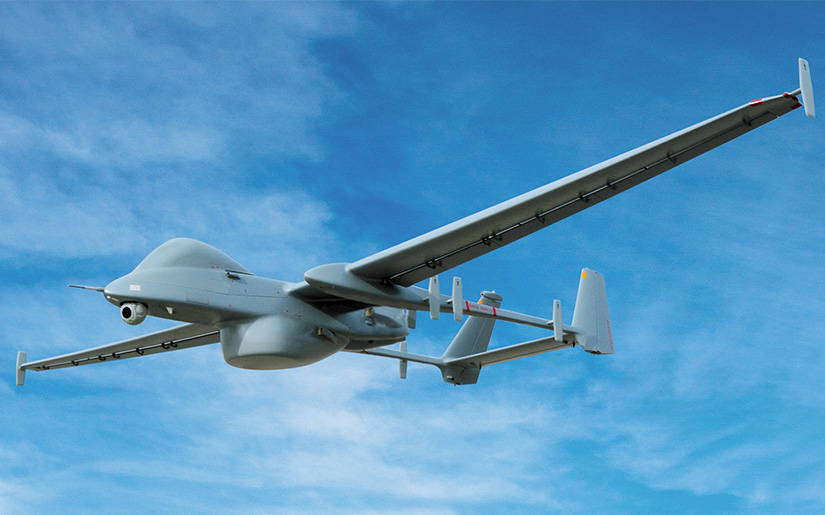
The RQ-5A Hunter is a twin-engine, twin-boom fixed-wing tactical UAV developed by Israel Aerospace Industries and fielded by the United States Army from the mid-1990s as its short-range unmanned reconnaissance system, retired from Army service in December 2015.
Overview
The Hunter was contracted in 1993 and entered US Army service around 1995–1996 as the Army's Short Range UAV for division- and corps-level reconnaissance. Program production was briefly cancelled in 1996 over management concerns, but low-rate production aircraft remained in service and production later resumed; the Army went on to field upgraded MQ-5B and MQ-5C variants alongside the original RQ-5A rather than replacing it outright with the smaller RQ-7 Shadow. The US Army's oldest RQ-5A systems flew their final mission at Fort Hood, Texas, on 16 December 2015.
Belgium acquired three Hunter (B-Hunter) systems in 1998, which became operational with the Belgian Air Component's 80 UAV Squadron in 2004 and were withdrawn from service in August 2020, replaced by the MQ-9B SkyGuardian. Wikipedia also lists the Philippine Air Force among Hunter operators.
Design and capabilities
Army-technology.com lists the RQ-5A at 7.01 m long with an 8.84 m wingspan and a maximum take-off weight of about 725 kg, carrying up to 125 kg of payload including a multi-mission electro-optical/infrared gyro-stabilized sensor turret. It is powered by two Moto-Guzzi petrol engines of 60 hp (45 kW) each in a push-pull layout on its twin-boom airframe, giving it redundancy if one engine fails. Army-technology.com lists a cruise speed of 111–148 km/h, a service ceiling of about 4,600 m, an endurance of about 12 hours, and a datalink-limited range of 125 km without a relay aircraft or 200 km with one. Wikipedia's figures for the type differ in several respects — a larger 10.57 m wingspan, an 885 kg maximum take-off weight, a 90 kg payload, diesel rather than petrol engines, and a 21-hour endurance — which may reflect a later upgraded configuration; Army-technology.com's variant-by-variant breakdown is used here for the baseline RQ-5A.
Operational history
Hunters supported NATO operations over Kosovo from Macedonia in 1999, flying more than 4,000 hours during the seven-month campaign, with at least seven aircraft lost. The US Department of Homeland Security trialled two Army Hunters for border-surveillance patrols over Arizona in 2004. The type deployed in support of Operation Iraqi Freedom from March 2003, and an armed MQ-5B variant made the US Army's first unmanned-aircraft weapon release, a laser-guided bomb, in September 2007. By early 2014 the Hunter fleet had passed 100,000 combined flight hours, and by the end of Operation New Dawn in 2011 had logged more than 110,000 hours. Belgium's B-Hunters deployed with EUFOR to the Democratic Republic of the Congo in 2006, suspending operations after an accident that October.
Frequently asked questions
What is the RQ-5A Hunter?
The RQ-5A Hunter is a twin-engine, fixed-wing tactical UAV developed by Israel Aerospace Industries and fielded by the US Army from the mid-1990s for reconnaissance missions.
How long could the RQ-5A Hunter fly?
Army-technology.com lists an endurance of about 12 hours and a datalink range of 125 km without a relay aircraft, or 200 km with one.
Why does the RQ-5A Hunter have two engines?
Its push-pull twin-engine layout was designed to give the aircraft redundancy and improve survivability if one engine failed.
Is the RQ-5A Hunter still in service?
The US Army retired its original Hunter systems in December 2015; Belgium withdrew its B-Hunters in August 2020. Upgraded MQ-5B/C variants remained in US Army use after the RQ-5A's retirement.
Who operated the RQ-5A Hunter?
Confirmed operators include the United States Army and Belgium; Wikipedia also lists the Philippine Air Force.