DJI Inspire series
DJI · China · also known as DJI Inspire 1, DJI Inspire 1 Pro, DJI Inspire 1 Raw, DJI Inspire 2, DJI Inspire 3, Inspire 3 · Updated
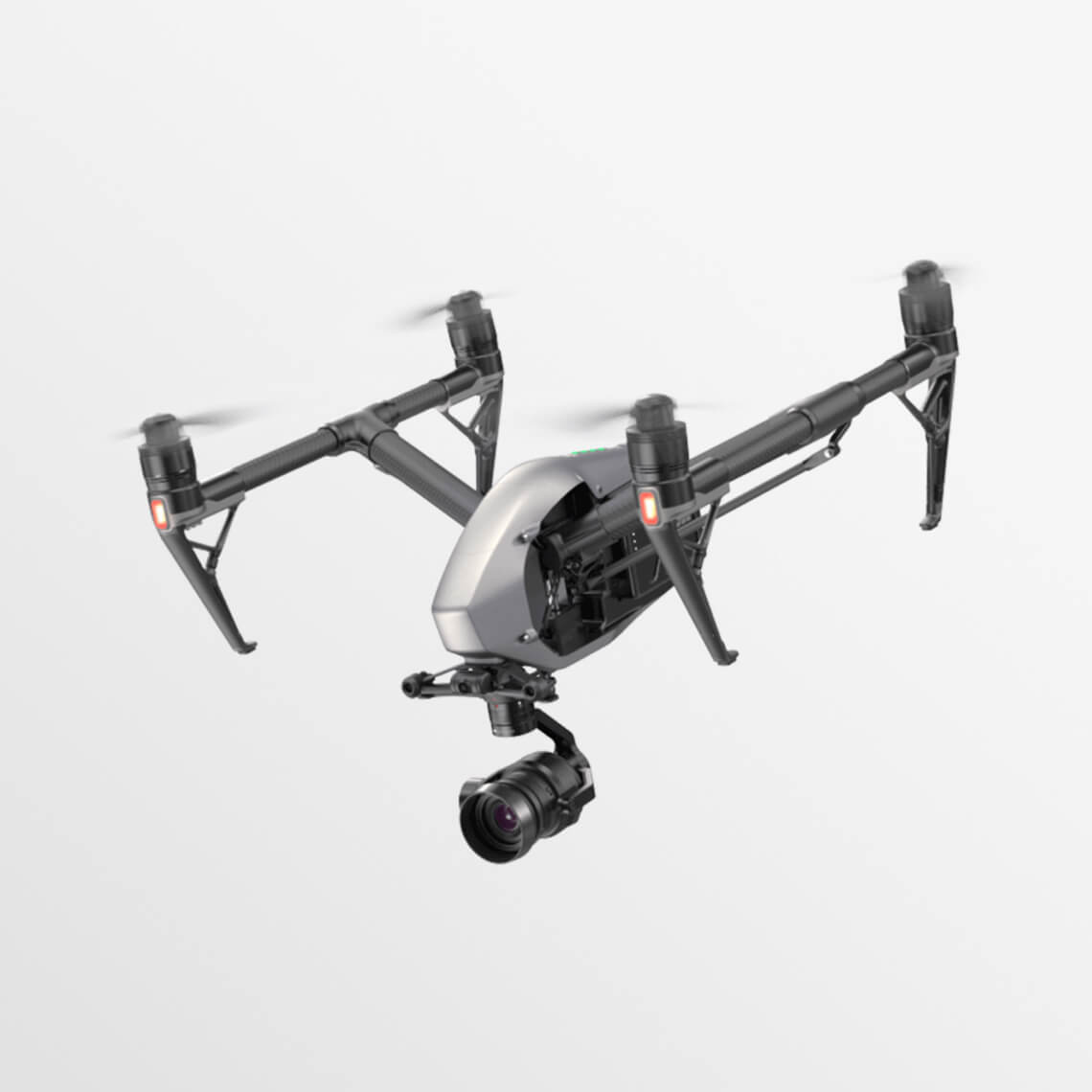
DJI Inspire series is a family of professional cinema camera drones developed by DJI of China, first announced in November 2014 with the Inspire 1 and currently represented by the Inspire 3, released in April 2023. The specifications on this page refer to the Inspire 3 unless stated otherwise. The Inspire 3 carries a full-frame Zenmuse X9-8K Air camera, weighs 3,995 g with camera and batteries (4,310 g maximum take-off weight), flies for about 28 minutes and reaches 94 km/h.
Overview
The Inspire line sits above DJI's folding Mavic series and is aimed at film and television production, commercials and high-end aerial photography. Its defining features are a rigid quadcopter airframe with retractable landing gear, Zenmuse gimbal cameras and a dual-operator mode in which one pilot flies while a second operator controls the camera.
DJI announced the Inspire 1 on 13 November 2014 with a transforming airframe that lifts the arms and landing gear clear of the camera's view and a 12-megapixel Zenmuse X3 4K camera. The Inspire 1 Pro and Raw (2015) added Micro Four Thirds cameras with interchangeable lenses, and the Inspire 2 (November 2016) introduced dual batteries and the Zenmuse X4S and X5S. The Inspire 3, announced in April 2023, replaced the modular camera mounts with a purpose-built full-frame 8K camera, added RTK positioning and omnidirectional obstacle sensing, and moved to the O3 Pro transmission system.
Design and capabilities
The Inspire 3 is a quadcopter driven by four DJI 3511s brushless electric motors turning 1671 standard or 1676 high-altitude propellers. DJI lists the aircraft weight as approximately 3,995 g including gimbal camera, two batteries, lens, PROSSD and propellers, and the maximum take-off weight as approximately 4,310 g; the specs block uses the take-off figure. Travel-mode dimensions are 500.5 mm long, 709.8 mm wide and 176 mm high, and the diagonal wheelbase is 695 mm with the landing gear raised. DJI does not publish separate unfolded flying dimensions, so the length and width in the specs block are the travel-mode values.
Two TB51 batteries of 4,280 mAh and 98.8 Wh each give a maximum flight time of about 28 minutes with the landing gear lowered or 26 minutes with it raised. Maximum horizontal speed is 94 km/h in Sport mode, ascent and descent speeds are 8 m/s, and the aircraft can take off and land in winds up to 12 m/s. The service ceiling is 3,800 m with standard propellers and 7,000 m with high-altitude propellers; the specs block uses the higher figure.
The Zenmuse X9-8K Air has a 35 mm full-frame CMOS sensor with a maximum resolution of 8192×5456 for stills and 8192×4320 for video, recording 8K CinemaDNG at 25 fps or 8K ProRes RAW at 75 fps, and full-frame 4K at 120 fps in slow-motion mode; it weighs about 516 g without a lens. A separate 161-degree FPV camera gives the pilot a 1080p/60fps view. Positioning uses RTK with GPS, Galileo and BeiDou, and nine vision sensors provide omnidirectional obstacle avoidance.
The O3 Pro system has a maximum transmission distance of approximately 15 km under FCC rules (8 km under CE, SRRC and MIC rules) for the FPV feed in single-control mode; this 15 km FCC figure is the range in the specs block. Streaming the gimbal camera at 1080p/60fps reduces the FCC figure to about 13 km, and dual-control mode reduces the FPV figure to 12 km. The United States launch price was 16,499 USD for the aircraft with the X9-8K Air camera, according to DroneDJ; DJI's specification page does not list a price.
Use cases
Inspire aircraft are used by film and television crews, commercial production companies and aerial cinematography specialists who need raw or ProRes footage that matches ground cameras. Dual-control mode and RTK-assisted repeatable flight paths suit scripted shoots, while the Inspire 1 and 2 were also used for real-estate, event and documentary work.
Variants
- Inspire 1 (announced 13 November 2014) – transforming airframe and 12-megapixel Zenmuse X3 4K camera; about 18 minutes of flight time.
- Inspire 1 Pro and Inspire 1 Raw (September 2015) – Micro Four Thirds Zenmuse X5 (Pro) and X5R (Raw) cameras with interchangeable lenses.
- Inspire 2 (November 2016) – dual-battery design with Zenmuse X4S or X5S cameras and 27 minutes of flight time with the X4S.
- Inspire 3 (April 2023) – fixed full-frame Zenmuse X9-8K Air camera, RTK positioning, O3 Pro transmission with 15 km FCC range, 28 minutes of flight time and 94 km/h top speed.
Frequently asked questions
What is the range of the DJI Inspire series?
The Inspire 3's O3 Pro system has a maximum transmission distance of about 15 km under FCC rules and 8 km under CE, SRRC and MIC rules in single-control mode. Streaming the main camera at 1080p/60fps lowers the FCC figure to about 13 km.
How long can the Inspire 3 fly?
DJI lists approximately 28 minutes with the landing gear lowered and 26 minutes with it raised, using two TB51 batteries.
How much does the Inspire 3 weigh?
About 3,995 g with the gimbal camera, lens, two batteries, PROSSD and propellers fitted; the maximum take-off weight is about 4,310 g.
What camera does the Inspire 3 use?
The Zenmuse X9-8K Air, a full-frame gimbal camera recording up to 8192×4320 video, including 8K CinemaDNG at 25 fps and 8K ProRes RAW at 75 fps.